Paul Heinz

Original Fiction, Music and Essays

Filtering by Tag: music

A to Z Music Challenge

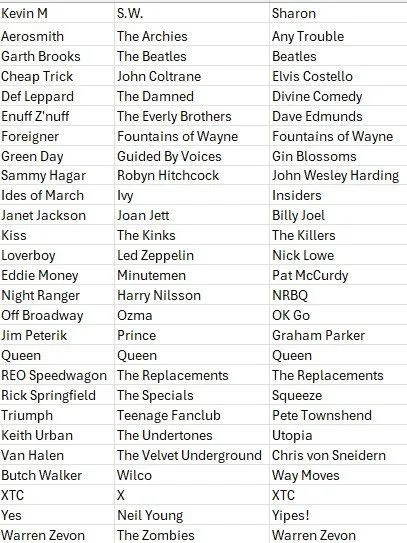
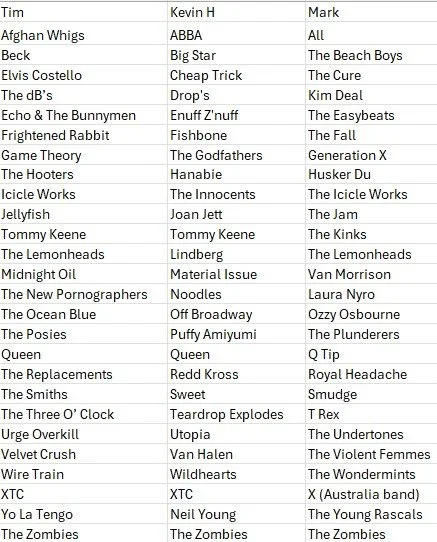
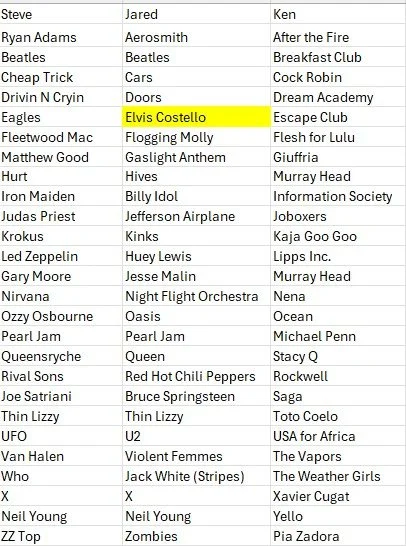
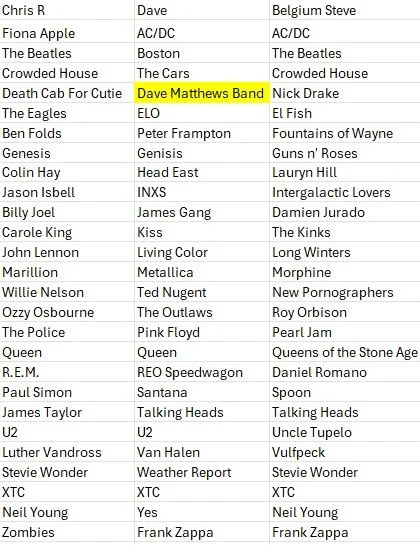
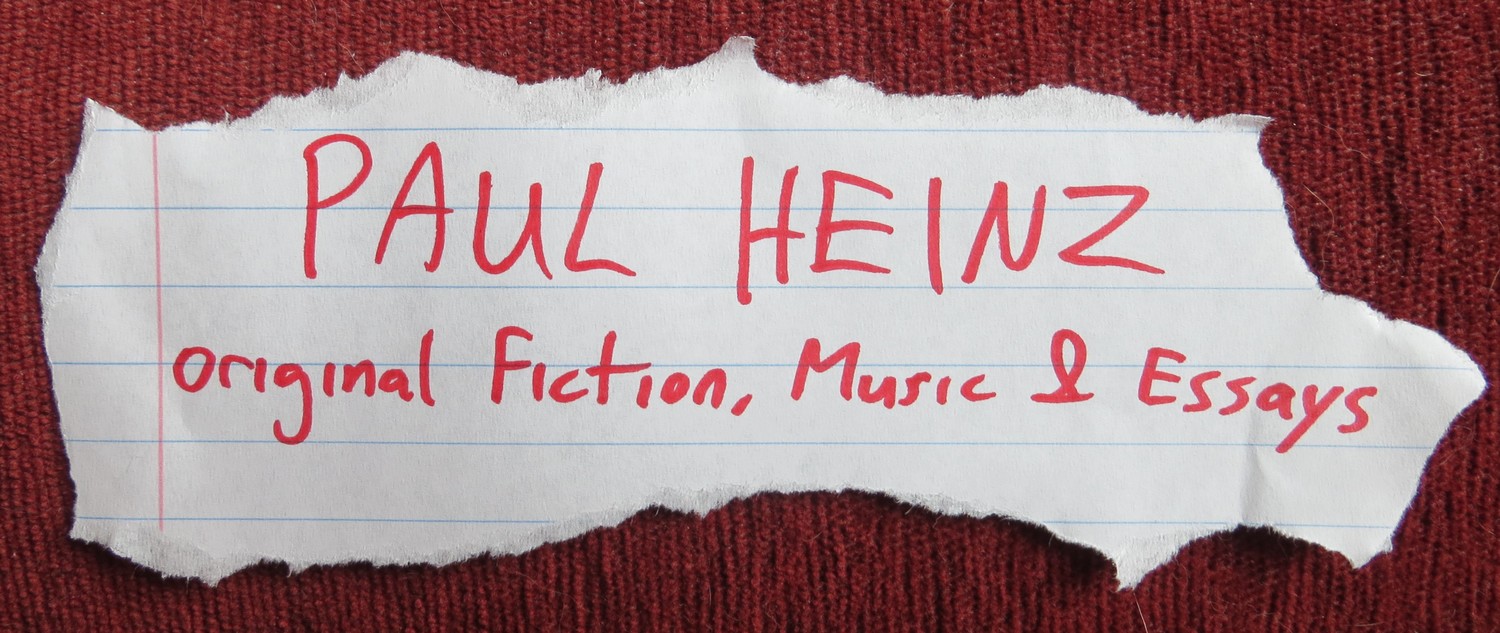
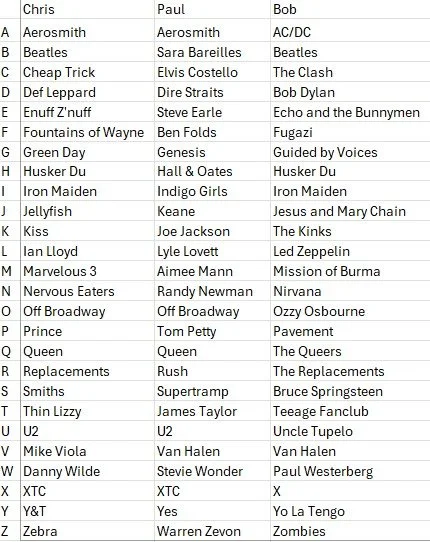
On the podcast 1000 Greatest Misses, co-host Chris and I submitted the following music challenge to our listeners: you’re sent to a desert island and are allowed to take with you the recordings of only 26 artists - one for each letter of the alphabet. Who do you choose? This challenge comes courtesy of my daughter and her partner who needed to kill some time while driving through Indiana last Thanksgiving. And what a great time suck it was!

Chris and I were delighted by the number of responses we received from listeners, further proving the point that although people aren’t always willing to tackle the pressing issues of our times, they will happily piss away a few hours on a completely frivolous endeavor! We thought it would be helpful to include everyone’s picks in one place so that they might inspire further investigation. There are tons of choices of artists I’ve never even heard of, much less listened to, and I hope to check some of them out in the days ahead.

For me, I stuck to rock and pop and didn’t go down the jazz or classical rabbit holes. Some letters - B, C, J, P, S - were exceptionally difficult, while others - G, N, O, Q, U, Y - were absolute no-brainers.

Consider coming up with your own choices before perusing the lists below. Please ignore misspelling, and please don’t shoot the messenger when it comes to entries that should have been disqualified (Elvis Costello as an E entry, for example); Chris and I didn’t catch some of these as they came pouring in toward the end of our podcast challenge. Also, consider checking out author S.W. Lauden’s Substack where he addresses the same music challenge. And yes, I am aware than Ken was messing with us when he chose acts like USA for Africa and Pia Zadora. All good!

My Classical Music Journey through the Baroque Period

Late last year, I decided to embark on a classical music-listening journey in 2025, hopefully learning a little something along the way and getting a better sense of how music evolved and what composers or types of music particularly speak to me. Accompanying me on my journey are a couple of excellent books to help me understand the context of the music I’m listening to. I’m six weeks in, and since I’m taking my journey in chronological order, I knew that some of the front end of this effort was going to be a little tough. I just finished with Bach last week, which means the next stage includes composers like Mozart, Hayden, Beethoven and Schubert. This part of the journey excites me more than what preceded it, but I thought I should at least summarize my feelings thus far.

The initial recordings I listened to were by composers of the 1100s through the 1500s, and this was more out of curiosity than an expectation of truly enjoying the listening experience. From Hildegard, Dufay and Des Prez, to Palestrina and Tallis, none of the music is something I’d seek out again, but I was intrigued by some of the musical conventions of the time. For example, the scale Hildegard Von Bingen uses is generally mixolydian, but ever-so-often she inserts a major seventh and a minor second in the scale, giving it a flavor that’s a bit foreign to my ears, and likely yours as well.

Traveling a few centuries later, the music becomes more metered and more polyphonic, with distinct parts for bass, tenor, alto and soprano, and harmonic conventions begin to take shape – harmony which today seems rather mundane, but which at the time must have been quite trailblazing and perhaps even outlandish to some people’s ears. The piece I listened to from Palestrina from 1550 uses a lot of Vsus4 to V to I resolution, a convention which today sounds so common that it’s a little dull, but it works, and it must have worked beautifully at the time.

I then moved on the Monteverdi, considered the father of the opera, and listened to several movements of L’Orfeo from 1607. This offered the first piece of music that I genuinely liked: I found the “Ritornello” and its soprano aria (if indeed I’m getting my terms correct) truly gorgeous. The opera also offered some lovely trumpet and violin parts that almost sounded like the klezmer music that was to come out of Eastern Europe centuries later. But after listening to 20 minutes or so, I became uninterested in the basic harmonies – there were flashes, but not enough to return to the piece.

Similarly, the Vivaldi concerto I listened to was all very pleasant, but ultimately unfulfilling. It was Stravinsky three centuries later who is said to have quipped, “Vivaldi didn't write 400 concertos; he wrote one concerto 400 times.” I only listened to one, and it was fine, but I wouldn’t want to hear another 399 of them!

For Handel, I eschewed his compositions that I was already familiar with, and instead turned to his Ode for the Birthday of Queen Anne from 1713. Here I was quite taken with movement’s I and V, the former gorgeous and serene, and the latter movement in 3/4 delightful, with impressive vocal runs and prominent trumpet. I was less taken with two later pieces by Handel – Zodak the Priest and Ombra Mai Fu from the opera Serse. The latter is considered to be a measure of beauty rarely achieved in music, but for reasons unknown it didn’t reach me despite it being a very pretty piece. Zodak the Priest for me suffered from the bombastic quarter note accents, emphasized by the timpani, similar to sections for his Water Music and Royal Fireworks pieces that I find tiresome.

The remainder of my journey through the Baroque period centered on Bach, widely considered to be the genius from which all other composers sprouted. Aside from some obvious pieces that I’ve enjoyed through the years  (Prelude in C, minuets in G and G-minor, Sheep May Safely Graze) I’ve never gravitated toward his music, it being of a high contrapuntal nature and less devoted to melody, the musical component which has guided nearly all of my musical interests and aspirations since childhood. I was interested to see if my opinion might change through a more thorough examination of the master’s works.

For me, listening to parts of Bach’s major works – The Brandenburg Concertos, the Well-Tempered Clavier, The Goldberg Variations and The Art of the Fugue – I was more taken with Bach’s mastery of the form and the incredible musicianship exhibited in the recordings than the music itself, if that makes any sense. Hearing Rosalyn Tureck’s piano performance of the “C# Prelude” was awe-inspiring, as was Glen Gould’s playing of The Goldberg Variations. What players! But of course, what music as well, with shifting keys and flipping melodies and crazy-challenging runs of allegro sixteenth notes. And it all hangs together so well. I like moments for sure, perhaps even sections of these pieces, but listening for five minutes, ten minutes, and beyond, for me it all starts to sound similar, with sections meandering and no discernible melody to latch onto.

Now, I know full well that my inability to find the melody in these pieces is my own shortcoming, not Bach’s. Having been raised on Elton John, Paul McCartey and showtunes, the advanced counterpoint of Bach is not a natural fit for me. I was happy to hear some samples, and I would be happy to hear some again in small doses, but these long pieces are not my jam.

Of the Bach pieces I listened to, my favorites were movements one and four of The Art of the Fugue, largely because I listened to an orchestrated version of these pieces that were originally likely written for a keyboard instrument. Instead, I was directed to the Stuttgard Chamber orchestra’s take on this piece, and I think that part of my issue with enjoying works like The Well-Tempered Clavier and The Goldberg Variations is that I’m less drawn to piano solo music than orchestration, this despite being a piano player myself who once recorded a CD of original piano solos.

Go figure.

But I found section one of The Art of the Fugue to be beautiful as a string piece, and section four varied the melody and tempo just enough to keep my interest. Then, sadly, it waned as I listened to section 6. By this point I was looking at my watch and wondering if I could hear a palette cleanser of some melodic rock and roll!

Anyhow, that’s my journey so far, and I hope to summarize the next stage of my musical escapade in a month or two.
2025: A Year of Classical Music

(note: to cut to the chase and read the list of classical music I’ll be listening to in 2025, scroll to the bottom)

Lately I’ve been fed up with talk radio and rock radio while driving around the Chicago area, and I’ve found myself absentmindedly tuning in to 98.7 WFMT, the local classical station, allowing me to appreciate what used to be a regular listening experience for me. My exposure to classical music has waned over the years, but it was significant during my childhood: between my parents’ listening habits and my piano lessons, band and choir concerts, solo and ensemble competitions and the like, not to mention an occasional concert in the park or local orchestral performance, classical music was very much a part of my life. As a young adult, when CDs became a thing, I’d buy the occasional classical CD, and I must have forty or so on the shelf today.

Although my active listening to classical music decreased when my children were young, my exposure to classical music was still significant, as my wife and I attended our children’s band, orchestra and choir concerts. It wasn’t until my children left home that this automatic exposure to classical music ceased, and I forgot to ramp up the intentional listening of my young adulthood. As a result, this music has mostly been absent from my life for the past decade or so.

It’s time to correct that, but I’d like to approach it in a concerted way (no pun intended). I’m going to devote 2025 to listening to classical music in a way I’ve never done before: consistently, repeatedly and intently. I’ve created a list of pieces to listen to over the course of the year, from some of the earliest choral works to musical pieces from the 21st century.

To what end? What’s the purpose? Mostly, I’d like to find additional pieces of music that I enjoy listening to. If I can find a few pieces that really wow me, or a composer or two I can explore further, then it’s mission accomplished. But I’d also like to have an overall better understanding of how music progressed over time, what the innovations were, and what some of the musical nomenclature of the classical world means. After all, I consider myself a musician, but there’s so little I know about classical music, and that shouldn’t be the case.

To help me with my cause, I’ve purchased three books on classical music:

1)      The Vintage Guide to Classical Music by Jan Swafford.

2)      The Rest is Noise by Alex Ross

3)      What to Listen for In Music by Aaron Copland.

I’ve completed the last book and was struck by a few observations by Mr. Copland:

“No composer can write into his music a value that he does not possess as a man.” (p. 212) This is very much a theme I considered when writing what is probably my favorite fictional piece that I’ve authored: “Nosebleed.” (2011, https://dc.cod.edu/cgi/viewcontent.cgi?article=1355&context=plr) I’d like to learn a bit more about the composers to help me understand their compositions.

Also from Copland: “When I hear a new piece of music that I do not understand, I am intrigued – I want to make contact with it again at the first opportunity. It’s a challenge – it keeps my interest in the art of music thoroughly alive.” (p. 199)  This is the spirit I’m going to try to tap into during my endeavor.

As always with these types of undertakings, there are some rules I’ll be following:

1)      I’ll only be listening to music that I don’t already know well. So, no Water Music, Eroica, Pictures at an Exhibition, The Planets, 1812 Overture, Mozart’s Clarinet Concerto, and the like. Sure, all of those pieces and many others could warrant another listen, but that will have to wait for another time. Of the pieces I’ve decided on, I think there are three or four I’ve heard before: Beethoven’s Symphony No. 7, Keith Emerson’s Piano Concerto No. 1, and Schubert’s Unfinished Symphony.

2)      I’ll be listening in chronological order, which should illuminate for me the progression of music through the centuries. 

3)      Each piece will be listened to, not watched. If the only way I can get a performance is on YouTube, I’ll stream the audio, not the video.

4)      I will listen to each piece initially without any knowledge of the piece aside from the year and the composer. Only after listening one time through will I consult the aforementioned books and a website or two to get some historical context.

5)      I will listen to each piece at least three times, allowing me to better absorb the music hopefully to the point of some degree of understanding.

I’d like to blog about my listening experience from time to time, though I’ll do so more from a layperson’s perspective, as my knowledge of music is mostly limited to the rock world. We shall see how this goes!

Without further ado, the following is the roadmap I intend to follow, though there could be some edits along the way. For many of the pieces, I’ll be listening to a particular movement or movements. My parents, my friend Uli and my daughter Jessica helped curate this list for me, along with several good websites devoted to the genre. The list below is color-coded to indicate which works I’ll be listening to in a given week.

A Year of Great Live Music

It seems crazy that for about 18 months in 2020 and 2021, there was no live music. I wasn’t watching it. I wasn’t playing it. I was, well…I’m not sure what the heck I was doing for those 18 months. Can you remember what you were doing? I think that the old John Steinbeck quote from Travels With Charlie rings true: “Eventlessness collapses time.”

By the end of 2021 I’d gotten a few gigs and dipped my toes into watching live music again: one outdoors and one indoors with masks on. Some great shows, but for me the floodgates really opened this year, 2024, a magical year for music that will surely provide the signposts necessary to truly remember the time period, rather than having it float away in the ether of my fading memory.

What’s particularly gratifying is that I saw eight acts I’d never seen before in six venues I’d never visited before, including two iconic sites: The Troubadour and The Hollywood Bowl. Both were very cool to check out and rectify the preconceived mental pictures I’d conjured (turns out that The Troubadour isn’t narrow and deep, but wide and shallow. Who knew?). In addition, I’m happy that at least half a dozen acts are producing legitimate new material. In other words, I wasn’t only scratching the itch of seeing legacy acts. Finally, as I wrote about a few months ago, I got to see shows with two of my kids, my wife, my sister, and a bunch of buddies, adding another element of good feelings.

Without further ado, here’s the list:

January 27, Black Pumas, Salt Shed (indoors), Chicago, IL
March 22, The Lone Bellow, The Troubadour, West Hollywood, CA
April 18, Graham Parker, Old Town School of Folk, Chicago, IL
April 20, Robert Cray Band, Des Plaines Theater, Des Plaines, IL
June 8, James Taylor, Ravinia, Highland Park, IL
June 16, Joe Jackson, Cahn Auditorium, Evanston, IL
June 27, Mike Campbell and the Dirty Knobs, Pat McCurdy, The Dandy Warhols, The Hold Steady, Summerfest, Milwaukee, WI
August 17, Sara Bareilles with opener Renée Elise Goldsberry, Hollywood Bowl, Hollywood, CA
September 18, Keane with opener Everything Everything Chicago Theater, Chicago, IL
September 26, Lake Street Dive, Salt Shed (outdoors), Chicago, IL
October 8, Charles Heath Quartet, Andy’s Jazz Club, Chicago, IL
October 17, Saga, Arcada Theater, St Charles, IL
October 24, Stevie Wonder, Fiserv Forum, Milwaukee, WI
November 1, BEAT (80s King Crimson), Copernicus Center, Chicago, IL

In addition to these shows, I played live eighteen times, plus a church gig or two, I recorded 50 podcast episodes, I completed an album, wrote additional songs for my next project, purchased close to 100 records and CDs…if I’m being honest, by the time I saw BEAT in November, I was kind of finished. It’s been a hell of a great year for music.

To date, I have tickets to only one show in 2025, and given the amount of money my family has been spending lately, that may be the way it has to stay. It’s time to do more writing, recording and producing and less consuming!

The Comfort of Moving On (When to Quit)

A few years ago, I heard former professional gambler and author Annie Duke on the marvelous podcast, “People I (Mostly) Admire,” hosted by economist Steve Levitt of the Freakonomics franchise. In Duke’s book, Quit: The Power of Knowing When to Walk Away, she discusses the art of quitting, and how many of us wait too long to walk away. After all, if there’s one thing a good gambler knows how to do, it’s “when to fold ‘em,” as the song goes. It’s important not to stick with a poker hand when the odds are telling you to quit.

Similarly, it’s important in life not to stick with a job, a pursuit, or a partner when every fiber of your being is telling you to get out. Steve Levitt summarizes Annie Duke’s book this way: “People stick with bad things almost always for too long, and we’d be better off if we quit things sooner.” Waiting too long causes us to stop progressing, to stop gaining ground toward our goals.

How often have you waited to quit an unfulfilling job out of fear and uncertainty, only to find that after doing so, you wound up telling yourself, “I should have done this years ago”?

Getting yourself to quit on time can be tricky. There’s an emotional pull in our society that makes quitting sound weak. We hear accolades for people’s “stick-to-itiveness.” We hear aphorisms like “quitters never win, winners never quit.” But what we might not hear is that a successful person who you admire might have quit three other goals before finding the one that worked, that an entrepreneur had two failed businesses before finding the one that succeeded, that a person left three romantic relationships before finding the one that clicked.

In order to grow, we have to allow ourselves to quit aspects of our lives that aren’t working.

Over the last year, I quit my two main music activities: I stopped playing at a church where I’d worked almost every Sunday for twelve years, and then last week I played my last concert with a local yacht rock band that I’d performed with for three years. In both cases I was playing with good musicians who were nice people. There was nothing awful happening in either scenario. Both allowed me to do what I do fairly well: play the keyboards. Both paid me a little cash that gave me a sense of contributing to my family (albeit, minimally). There were reasons to stay.

But neither musical act was fulfilling. I wasn’t inspired. I wasn’t stretching myself as a player. I was showing up, playing, collecting a check, and going home. That’s not what I want out of music. I think of drummer Bill Bruford quitting Yes, Gregg Rollie leaving Journey, or Sting pulling out of The Police, each at a point when those bands were at their creative peaks. There were all sorts of reasons to stay, but they each decided it was time to walk away.

Now, leaving a church gig and local yacht rock band pales in comparison to the above examples, but despite a multitude of reasons to stay, I quit both of them, and if I’m honest with myself, later than I should have. You know you’ve made the right decision when after quitting you feel a little lighter, a little freer, and that’s how I feel now.

Now it’s up to me to put that new energy into action, and to proudly carry the mantel and say, “Yeah, I’m a quitter.”

Copyright, 2026, Paul Heinz, All Right Reserved