Paul Heinz

Original Fiction, Music and Essays

Aging Like Peter Gabriel

Aging can be scary.  Just ask my daughters about Peter Gabriel.  But first, a little background…

In 1994 I mentioned to my friend Julie that I thought my hairline was starting to recede.  “Well, duh!” was her response.  Apparently, I was the last to know.  Or maybe the last to know was Alice, my wife, because I managed to snare her prior to my long descent into baldness.  2013 helped spur the aging process, as I put on about seven pound and purchased my first pair of reading glasses.  I figure it’s only downhill from here.  There are exceptions to men aging in unattractive ways: say, George Clooney, Cary Grant, and every man who’s ever played James Bond.

But for me, I think I’m going to go down the path of Peter Gabriel (except for the world stardom part).

Gabriel didn’t really reach world stardom until his album So in 1986 when he was thirty-six years old, a fairly elevated age for a rock performer’s peak, but even six years later, when he toured behind his follow-up album Us and sang about aging issues like divorce, he looked good.  Svelte.  Tireless.  Exuberant.  When my daughters were young, we would play Gabriel’s Secret World DVD over and over, mesmerized by the visual spectacle of the show as much as the musical performances.  Still own it.  Still love it.

And then…

As Gabriel is wont to do, he stayed largely hidden from public view for a number of years, but appeared in 1999 at the Academy Awards to sing Randy Newman’s song “That’ll Do” from the movie Babe - Pig in the City.  You could almost hear the audience gasp as he came onto the stage.

Check out the reaction that people shared on-line immediately following the Oscars (under the heading “Peter Gabriel YIKES”).

My favorite line is: “My husband came into the room and asked me why Marlon Brando was singing.”

Big deal, right?  People age.  Except it was only SIX YEARS AFTER the Secret World tour!  The man went from this…
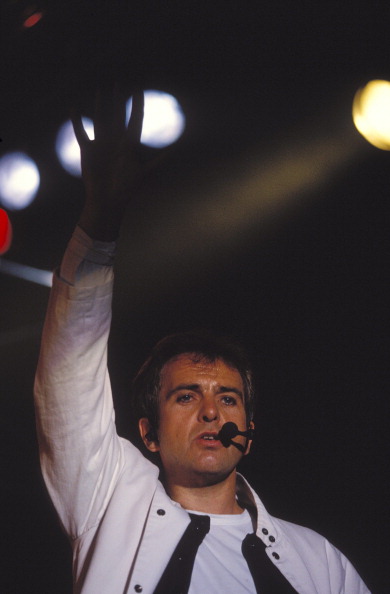

…to this…
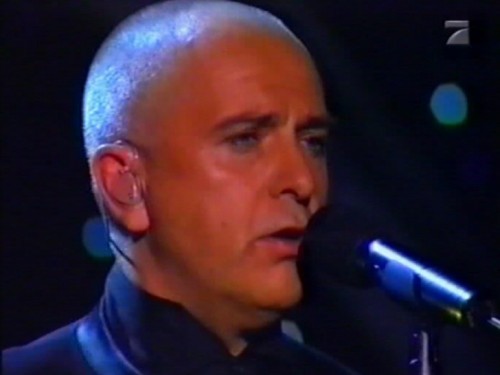
...from the age of 43 to 49!

I’m 45, smack dab in the middle of the road that goes from “tolerable looking” to “ewww”.

Four years after Gabriel’s Oscar performance, I rented the DVD of his Up tour, excited to once again show my daughters an inspiring Peter Gabriel concert.  I don’t want it to sound like I’ve raised two shallow-minded girls, but they practically cowered while watching the hairless, bloated figure on screen.  They were only six years old, but they knew a cover up when the saw one.

“This is the same man?” they asked.

“It is.”

“Are you sure?” 

I wasn’t.  They went back to playing with their Barbies, and I finished the DVD, searching for a melody in tunes like “More than This” and “Growing Up.”  It was as if the songs had suffered the same fate as their creator, plodding along, suffocating beneath their own weight.

It’s said that people see themselves at a certain age, frozen in time, and are shocked and betrayed when the mirror shows their true age.  But better to live by that internal age then the external one.  Better to be surprised when looking into the mirror than validated.

I guess that's the trick.  So I've decided I'm going to live like I'm twenty-one and see what happens. Should be divorced and homeless within a month's time.

Misuse of "Literally"

On TV last week a sportscaster who shall remain nameless said something along the lines of the following: “When they pulled him from the game, he was literally scratching and clawing the floor.”

Yep.  The guy was actually digging his finger nails into the basketball court.

You might be willing to give a sportscaster a free pass.  Call it a minor variation of the old Woody Allen joke from Annie Hall:  “Those who can’t do, teach; those who can’t teach, teach gym.”  But yesterday my daughter’s teacher who shall not only remain nameless but whose subject will be withheld to protect his/her identity said, “You are literally shooting yourself in the foot if you don’t study for this exam.”

Now, we all say dumb things sometime.  Goodness knows that if compiled all the stupid, erroneous or regretful things I’ve said in my lifetime and shared them on a blog for all to read, I’d be in prison, divorced and friendless.  And in this day and age, when so much of what we do is recorded in some fashion, the occasional flub should be forgiven (Dan Quayle’s misspelling of potato back in 1992 caused him endless grief, but heck, for years I was convinced that there was a silent ‘n’ in the word dilemma.  Fortunately, I’m not alone in this mistake.  Back in grad school my friend Don was convinced about the silent ‘n’ as well, and according to this website, there are thousands among us!).

Flubs are one thing.  But when our high school teachers and news broadcasters consistently promulgate an incorrect use of a word (irregardless, anyone?), then we have a bit of a problem.

Or do we?

Martha Gill of The Guardian recently wrote a post about the word literally and cites several instances of the word’s mishandling over the years.  It might be of some comfort to learn that the misuse of the word literally has occurred for – literally – centuries.  But in the Internet Age, when mistakes are repeated and amplified at the speed of light (figuratively, not literally), it's become so rampant that some dictionaries are officially changing the word's definition. 

Gill comes to the conclusion that we should simply avoid the word entirely.  She writes: “At the moment (literally) is irredeemable. It is a moot word. We just have to leave it up in its bedroom for a while until it grows up a bit.

She may be right. 

Sure, you can fight the trend and correct your friends when they say things like, "Oh my God!  I literally died!"  Alternatively, you could opt for a more passive approach:

Or you can simply avoid the word altogether and move on, accepting that language is fluid, confusing and, at times, infuriating.  After all, doing otherwise could cause your head to figuratively explode.

What makes you cry more? Happy-Sad or Sad-Sad?

Last week my daughter made the following statement: “Happy-sad evokes a stronger emotional response than sad-sad,” referring to the many movies that make us tear up.  Rather than take this statement at face value, we went through the list of the movies that make us cry:  some by her, some by me, and some that we both agreed on.  Here’s what we came up with:

Cinema Paradiso

Field of Dreams

Dances with Wolves

To Kill a Mockingbird

The Color Purple

Awakenings

The Perks of Being a Wallflower

Titanic

Magnolia

The Natural

Sense and Sensibility

It’s a Wonderful Life

Schindler’s List

Forrest Gump

E.T.

Eternal Sunshine of the Spotless Mind

Roman Holiday

Finding Neverland

The Sixth Sense

Avalon

We could have named another dozen or two, undoubtedly.  Michael Phillips of the Chicago Tribune cried at the movie Up, but I’ve seen it so many times now that I can’t remember if I cried the first time.  I probably did.  Other movies people seem to mention a lot are ones I haven’t seen: Marley and Me, My Girl, The Notebook, etc.

Looking at the above list, I can draw a few conclusions:

1)      Actors Henry Thomas and Haley Joel Osment are fricking geniuses and Thomas should have been nominated for an Oscar.  Kids are too often overlooked, though thankfully Osment did get a supporting actor nomination.

2)      Music is the big emotional manipulator.  Aimee Mann’s song “Wise Up” in Magnolia kills me – KILLS me – every time.  And don’t get me started on Randy Newman’s waterworks-inducing scores to Avalon and Awakenings.

3)      Steven Spielberg could be paid based on tears and do quite well.

4)      Music isn’t an absolute necessity to induce tears.  Sometimes silence is the best soundtrack for us to feel raw emotion.  Watch this clip from The Sixth Sense:

5)      Happy-Sad movies – those that produce a tear even when conveying a happy or bittersweet moment – produce far more tears for me than downright sad movies.  And many movies have sad scenes that don’t evoke as much response from me as the happier moments minutes later.  Case in point: in To Kill a Mockingbird, I don’t cry when Tom Robinson is wrongly convicted of rape, but I do cry when Scout recognizes Boo Radley in her brother’s bedroom near the movie’s end.  Another example: in It’s a Wonderful Life, the only moment that gets me every time is when Ernie reads the telegram from Sam Wainwright.  There’s something about a guy who’s willing to stick by a friend even after losing his girlfriend to him that resonates with me.  Again, this scene plays without music and works beautifully.

Below is the list my daughter and I comprised, this time with an HS for happy-sad and an S for sad.  Happy-sad wins out by a mile for me.

Cinema Paradiso (HS)

Field of Dreams (HS)

Dances with Wolves (HS)

To Kill a Mockingbird (HS)

The Color Purple (HS)

Awakenings (S)

The Perks of Being a Wallflower (HS)

Titanic (S)

Magnolia (S)

The Natural (HS)

Sense and Sensibility (HS)

It’s a Wonderful Life (HS)

Schindler’s List (S)

Forrest Gump (HS)

E.T. (HS)

Eternal Sunshine of the Spotless Mind (HS)

Roman Holiday (HS)

Finding Neverland (HS)

The Sixth Sense (HS)

Avalon (S)

What is it about a bittersweet or happy moment that fills us with emotion that exceeds even that of the dourest occasion?  Do we respond to happy moments with the same emotional level in real life, or are we merely being manipulated by the creators of a constructed art form?  If our real lives were accompanied by a score, would we be crying constantly?

The Phrase "Spoiler Alert."

The invention of the phrase “spoiler alert” has got to be one Man’s greatest linguistic contributions over the last decade or so.  Philip B. Corbet of The New York Times has rightly pointed out how overused the phrase has become, and how it’s often used incorrectly, but for my money, overuse is preferable to the alternative.

I think of the woman who came to my home in 2002, and who – after eating our food – thanked us by divulging the ending of the movie, The Others.

I will do for you what she didn’t do for me.

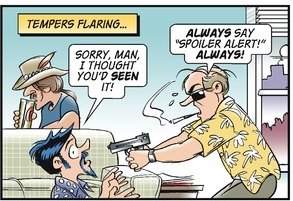
!!!!SPOILER ALERT!!!!

She opened up that pouty little mouth of hers and spewed out, “I couldn’t believe it when I learned her children were dead.”

She is very, very lucky that I didn’t resort to the following (or worse): 

After her egregious case of vomit of the mouth, it didn’t matter to me if she was smart or pretty, if she’d overcome obstacles in her life or helped the needy.  I couldn’t possibly care less if she gave twenty percent of her earnings to charity or if she was raising three perfect little angels.  None of that shit mattered to me.  What mattered is she opened her mouth and ruined the ending of a movie I was excited to see.  Yeah, the film had already left theaters and moved into video stores, but to me, there is no statute of limitations when it comes to revealing secrets about a piece of art.

I still haven’t told my kids about the ending of Psycho.  I’ll never divulge the meaning of Rosebud, whether or not Thorwald really murders his wife, and where the quarter of a million dollars is hidden in the movie Charade.  That’s for them to discover.  And I sure as heck won’t mention a word about The Sixth Sense.  Sure, I could try to ease my kids’ anxiety and mention !!!SPOILER ALERT!!! that the ghosts are actually trying to help, that they’re good guys (never mind the movie’s Big Secret).  I resorted to this tactic when my kids were younger watching E.T. for the first time.  !!!SPOILER ALERT!!! “The bad guys are actually good guys,” I said, attempting to alleviate their trepidation, but I’ll never do this again.  It kills the journey.

Some people just don’t get it, including – unfortunately – much of my family.  Last summer my sister-in-law blurted out the secret behind the musical, Next to Normal, the same day my daughter was to see it.  And just last month, my mother, in response to an email of mine indicating that I wanted to see the movie Enough Said, wrote the following email !!!SPOILER ALERT!!!:

I fell in love with the Soprano guy, what an appealing person.  Was Julia's character vulnerable, screwed up, or just terribly unkind?

Yep.  So now I know the ending of that movie, too.  Thanks, Mom.

I think when it comes to discussing books, films and theater, we could look to my sister for guidance.  Her advice for living in a world in which the excretion of opinions is as commonplace as breathing is this:

Shut your trap.

Tripping on the (Prerecorded) Wire

Watching two bands perform last night at Evantson’s SPACE – a splendid venue, by the way – I noticed how dependent live performance has become on prerecorded tracks.  This is nothing new, of course, as even bands with reputations for being authentic – whatever that means – have enhanced their shows with the extra hands that sequencing and loops provide.  The band Rush has been relying on prerecorded tracks for decades.  Geddy Lee sings a lead vocal, and suddenly two more Geddys join him in the background.  And watch closely when he plays the keyboards and you’ll notice that often he’ll press one note on the keyboard that triggers a more elaborate arrangement.  Modern cover bands often employ the same tactics – backup vocals sound especially impressive when they’re dubbed over a layer of lush, prerecorded voices. 

Neither band I saw last night – headliner A Silent Film and opener Hands – relied so heavily on prerecorded tracks that it diminished the talent or energy displayed on stage (both bands were excellent), but it doesn’t take much for live performance to become predictable, and this is exactly what playing to prerecorded tracks demands: predictability.

Back in the day, recordings were meant to capture live performing, but along the way that method was turned on its head; soon, live performing was meant to emulate the recording.  Some bands – The Cars come to mind, but almost any top 40 band could be an example – performed their songs exactly as they sounded on the record.  Others – The Who and Led Zeppelin, for example – managed to perform a high wire act that took listeners on a journey that could either flop or mesmerize but never bore, as they played songs that were contradictorily both recognizable and an exploration of new territory.

There’s room enough in the world for both strategies, but more and more it seems that bands are relying so heavily on pre-sequenced material that any hope to elevate a performance to transcendental levels is squashed from the outset. 

And this is a problem.  In an era when the recordings have become disposable and live performing has become the one think keeping both listeners and performers invested and interested, the need for spontaneous performances has never been greater.

Sure, Hands did a fine job last night, and there’s no question that the band has talent and live chops (particularly drummer Sean Hess), but the songs relied so heavily on Geoff Halliday’s sequenced synth tracks, that each song was undoubtedly performed exactly the way it had been performed the day before and the day before that.  There’s simply no room for improvising.  No possibility of a happy accident.  If a particularly inspired groove or guitar solo happens to develop, there will be opportunity for it to flourish.

Hell, even The Who can’t be spontaneous with songs like Baba O’Riley or We Won’t Get Fooled Again, since they have to rely on the synth tracks Pete recorded over forty years ago.  Luckily for The Who, back in the day these songs were the exception to an otherwise spontaneous performance.

A Silent Film, which relied much less on prerecorded tracks than their opening act, announced a few songs into the set last night that they were going to perform without a set list, insinuating that this was A Big Deal.  Perhaps these days that’s what passes for spontaneity – playing songs exactly like the record, but in a different order.

But will it keep audiences coming back?  Will it breathe life into a faltering industry?

Copyright, 2026, Paul Heinz, All Right Reserved