Paul Heinz

Original Fiction, Music and Essays

Filtering by Category: Sports

Bet on the Brewers? Um...no.

It’s been one long writing hiatus (my longest since starting this website),  but in my defense I was extremely busy watching baseball.  When I invested yet again in MLB.TV at the beginning of the season, I had assumed that by mid-May my lowly Brewers would be bringing up the rear and I’d be onto other summertime activities like tending the garden and exercising (oh yeah, and writing). Fortunately, the Milwaukee Brewers have saved me from that fate, and while my tomatoes are suffering from dry rot and my waste line is enjoying recent growth, my Brewers are in first place by 51/2 games at the All-Star Break.

Surprised?  Well, yeah, but perhaps less by the Brewers and more by the other teams in the NL Central.

I had predicted a win total of perhaps 77-83 wins this year, an improvement over last year’s 73, but not enough to make a shot at the playoffs, especially with the Cubs and Cardinals in the division.  And that’s the real surprise, that to date these two teams haven’t been able to get it together.  As for the Crew, well...there’s still time to meet my prediction.  Yes, I’m cautiously optimistic, but I also have a memory, albeit one that regularly forgets where I placed my phone.

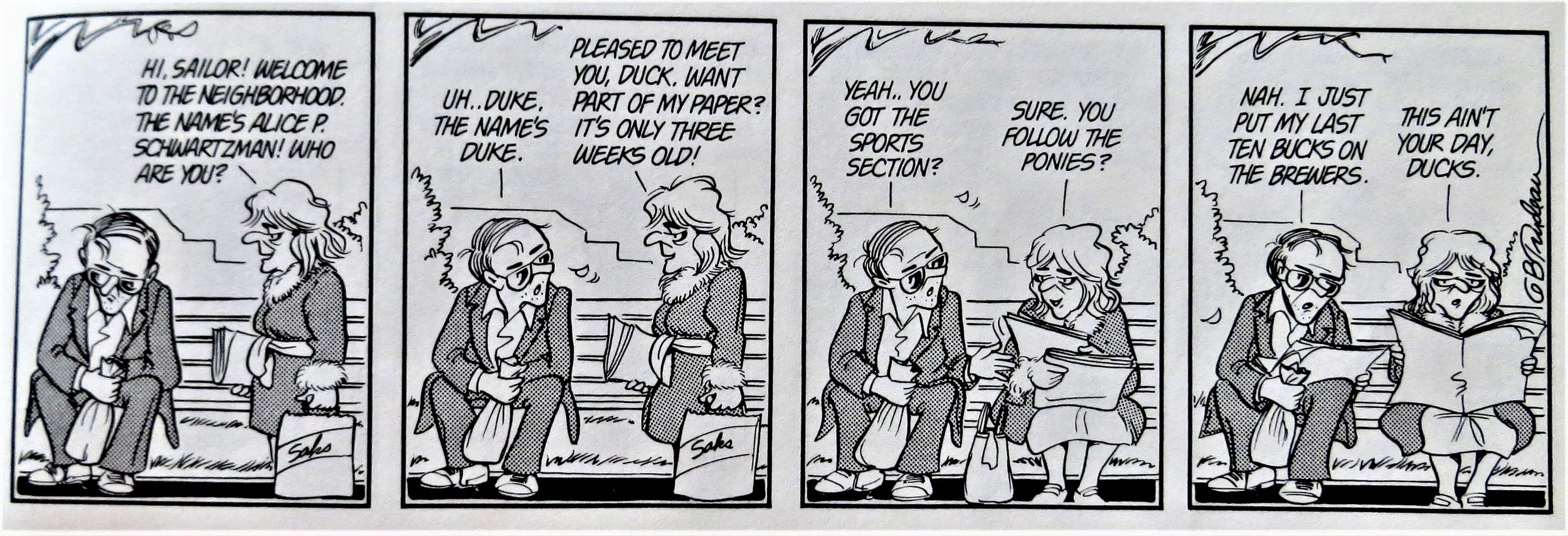
As the Doonesbury character Duke discovered back in 1982, it’s never wise to bet your last ten dollars on the Brewers.
Brewer fans don’t need long memories to remember two disastrous second half collapses.  We need go no further back that 2014, the year the Brewers enjoyed the best record in baseball and a 6 ½ game lead at the end of June, only to go 31-47 the rest of the way to finish third with an 82-80 record (which ordinarily would have been a pretty good season for the Crew).

And let’s not forget a decade earlier, when the Brewer suffered the worst second half ever for a team that entered the All-Star Break with a winning record, going 22-53, scoring two or fewer runs 33 times, and finishing last in the division.

And even in 2008 when the Brewers managed to make the playoffs for the first time in 26 years, the Crew had a terrible September, going 4-15 before winning six of their final seven to squeeze into the post-season with a 90-72 record.  It got so bad that final month of the season that Ned Yost was fired as manager with just 12 games to play.

Will the 2017 Crew suffer a similar fate?  Hard to say, but there are a few reasons to remain optimistic.  First, this year’s team has suffered some enormous blows without folding, two of them the result of National League rules.  Opening day starter Junior Guerra lasted just three innings before going on the DL after injuring his leg leaving the batter’s box.  Similarly, Chase Anderson - the best Brewers starting pitcher this season - suffered an oblique injury while taking a swing and will be out likely until the end of August.  Add to that the continued injuries of Ryan Braun (no steroids equals no playing time, apparently), and you might expect this team to struggle.  Not so.  The bench on this team as constructed by general manager David Stearns is deep, so much so that manager Craig Counsell claims his team doesn’t have a bench.  Rather, they have interchangeable parts, all of them formidable, from waiver acquisitions Eric Sogard and Stephen Vogt and trade acquisitions Travis Shaw and Manny Pina,  to utility men Hernan Perez and Jesus Aguilar to recent signee Eric Thames, every day seems to highlight a new hero.  If there’s cause for concern, it’s the alarming number of strikeouts (the Crew one again leads the league in this category) and I have to wonder how the lineup is going to fair against the elite pitchers on the Dodgers and Diamondbacks.  The weakest link in the chain so far is center fielder Keon Broxton, who - despite moments of brilliance and solid defense - can’t seem to find any consistency behind the plate, and it wouldn’t surprise me if he isn’t a Brewer next year.

But if the Brewer position players generally lead one to feel optimistic, the pitching staff may cause a few fans to squirm in their seats.  When Matt Garza is your third most reliable starter, you might concede that the second half could be rough, yet somehow through it all - through injuries to two starters and a bullpen that struggled mightily early in the season, Milwaukee has the 8th best ERA in the Major Leagues.  And recently the starting staff, bolstered by Anderson’s replacement Brent Suter and a reinvigorated Jimmy Nelson, has finally given the bullpen some rest after it was overused for the first two months of the season.  Will the young pitching staff be able to stay strong throughout a long second half?  This is the biggest question mark the Brewers face, and no doubt one that David Stearns is eying carefully.  

If I’m allowed to alter my prediction of the 2017 Milwaukee Brewers, it would be to add 4 games to the total.  Instead of 77-83 wins, I think they have a chance to finish with 81-87 wins.  Enough to win the National League Central?  Possibly, but I doubt it, as I keep thinking the Cardinals and Cubs will eventually find their way and turn the 2017 Brewer season into a pleasant surprise, but not one that includes games come October.

Either way, I’ll be watching baseball and procrastinating on my hope to one day write the Great American Novel.  But will I bet my last ten dollars on the Crew?  Not a chance.  

But next year?  Quite likely.

Who's to Blame for our Topsy Turvy World?

In a recent article by Kadeen Griffiths regarding the upcoming HBO film, The Immortal Life of Henrietta Lacks, actor Courtney B. Vance says, “The world is topsy turvy, and everyone is out for themselves. It shouldn’t be like that.” This phrase, topsy turvy, has been coming up a lot in conversation lately, because it seems as if our world has truly been turned on its head, and it’s easy to see who’s to blame.

Number 1 seeds are losing to number 8 seeds (the Blackhawks are the first NHL or NBA number one seed to ever be swept in the first round).

Fox News is now holding its hosts to a higher standard than the American public holds its elected officials.

Oscars winners are announced and then withdrawn.

The White House has gone from hosting Paul McCartney and Stevie Wonder to Ted Nugent and Kid Rock.

Superbowl leads of 25 points are forfeited in a quarter and a half.

Alternative truth has become a phrase in our lexicon.

And who set the wheels in motions for this topsy turvy world? No, not Trump. He was merely a by-product. Instead, turn your attention to six days earlier during the waning minutes of November 2 when the Earth shifted slightly from its axis and allowed a little rain to fall onto Cleveland, Ohio. I’d gone to bed early that night (just as I would on November 8) and when I awoke after a brief nap, I thought to myself, “Holy shit! I don’t hear fireworks. The Cubs must have actually lost!” The lovable losers had been up 6-3 in the 7th when I called it a night feeling mildly depressed because without the Cubs, Red Sox and White Sox to make fun of, who was left except my lowly Brewers?   

And then I heard it. The sound of fireworks. Yes, the Indians had come back, ready to claim their first World Series since 1948, but a rain delay turned the fate of the world upside down that evening.

Now, my depression that night and following morning can’t compare to the sick, festering depression that much of America has felt since November 8 and will continue to feel as the country unravels, but there’s no doubt in my mind that the Cubs set the wheels in motion. 

Thanks a fricking lot, Cubbies. Enjoy your little victory dance as defending World Champions while the world crumbles all around you. You’re expected to make another playoff run this year, but hey, in this topsy turvy world you started, don’t get your hopes up.

In fact, in this topsy turvy world, my Brewers might actually have a shot.

Recap of the Brewers' 2016 Season

That the Milwaukee Brewers managed to win 73 games in 2016, a full five games ahead of their disastrous 2015 season, is nothing short of miraculous when considering that the team they fielded consisted of so many players with little to no major league experience. Add to that the mid-season trades of four of their more productive players – Aaron Hill, Jeremy Jeffress, Will Smith and their all-star catcher, Jonathon Lucroy (all of whom played for teams that made the playoffs this year; more on that in a moment) – and it’s amazing that the team was able to finish as strongly as they did. At the July 31 trade deadline, the Crew was 47-56, on track to win 74 games.  They finished just one game short of that pace during the remaining two months of the season despite fielding a team made up of players who had just spent time in the minors.  Hell, they even took care of the Cubs and Pirates during September. Pretty incredible.

Front and center of the team’s return to somewhat respectability is Hernan Perez, a jack of all trades defensive player who since coming from Detroit a year ago has shown that he belongs in the Major Leagues. Jonathon Villar isn’t far behind. He strikes out a lot, but the guy was one home run away from the coveted 20-60 clubs of 20 home runs and 60 stolen bases, finishing with 19 and 62, respectively. Not too shabby. Strong finishes of Keon Broxton, Domingo Santana and rookie Orlando Arcia, plus a return-to-form season for Ryan Braun – a few nagging injuries and regular off days aside – helped the Brewers hold their own for the most part, even down the stretch. Second baseman Scooter Gennett also proved himself as a capable starter by figuring out how to hit left-handed pitching. His status as an unmovable infielder may make him a short-term contributor to the team as it positions itself for the future, but Gennett has clearly proved himself as a legitimate starter or platoon player somewhere, if not Milwaukee. Chris Carter, who amazingly finished tied for first in the National League in home runs, also led the league in strike outs and batted .222 with only a .321 on-base percentage. A contributor, for sure, but not exactly the first baseman the Crew has been longing for since Prince Fielder’s departure five years ago. If the Crew hopes to compete in a year or two, an upgrade at first base may be needed.

On the pitching side, manager Craig Counsell was able to piece together just enough starting pitching to hang in there until the sixth inning, when he could hand the reigns to a fairly solid relief core that was initially hampered by a bizarre injury to Will Smith but bolstered by performances from Tyler Thornburg, Carlos Torres, and Jeremy Jeffress. Starter Zach Davies proved once again that he’s a force to be reckoned with, and the big surprise of the year goes to starter Junior Guerra, who at age 31 had rookie-of-the-year type numbers before exiting due to injury. I had hoped the Brewers would trade him at the end of July when he was hot, but who knows – the guy could end up being a contributor for years to come.

As a Brewer fan, watching former Milwaukee players enjoy amazing seasons and careers is a constant source of frustration. Last year's Brewers shortstop Jean Segura had a terrific year for Arizona – leading the league in hits and batting .319 – and left fielder Khris Davis finished with 41 home runs for Oakland (along with a piss-poor OBP).  Carlos Gomez finished strong with the Rangers, and don’t get me started on the former Brewers who’ve played with the Royals the past four or five seasons, plus JJ Hardy is still having a great career with Baltimore, etc.  It begs the question: is there something wrong with the Brewers’ coaching staff that can’t get the best out of their players while they’re in a Milwaukee uniform? Add up all the former Brewers in MLB, and you’ve got yourself a pretty damn good team. Of course, being among the smallest two markets in baseball, Milwaukee can’t afford to keep most players around too long, but lately general managers Doug Melvin (until last year) and now David Stearns have been dishing players off before they’re even arbitration eligible, much less free agents. Probably not a formula that can continue for too long if the team hopes to compete in the near future, and one has to wonder if the Brewers could have actually competed this year had they kept onto some of their core players. Perhaps not, and perhaps in a few years fans will reap the benefits of rebuilding, but the organization is going to have to find a way to tap into the talent of players while they’re in Milwaukee instead of seeing glimpses of talent that end up maturing elsewhere.

Still, as a fan, it was a fun season to watch, in that I had absolutely no expectation for this team. Watching young guys compete can be a satisfying endeavor even when the end results aren’t perfect. The Brewers could manage to get back to a .500 team next year and perhaps manage a winning season in 2018, but it’s going to be a tough road. We’ll see if the Cubs continue their hapless ways in the playoffs this year, but make no mistake – they are going to be good for a long, long time, and with a one-game wildcard playoff (which I hate), it may be a long while before the Brewers actually get to play a legitimate playoff series again. GM Stearns may be ahead of where many of us expected the Crew to be at this point, but he and the team still have a long way to go.

Either way, I’ll be watching and likely losing more hair in the process.

Why Brewers Fans should be Encouraged

As a lifelong Brewers fan, I admit that watching the Kansas City Royals battle for their first World Series title in twenty-nine years gives me just a twinge of discomfort.  After all, three of the Royals’ starters are former Brewers who Milwaukee dealt in trades (Escobar, Aoki and Cain) and two are players the Royals acquired as a result of the Brewers dealing Jake Odorizzi to KC in the Zack Greinke trade (Shields and Davis).  The Aoki trade – one that upset me at the time – paid dividends as Will Smith stymied hitters consistently before Brewer manager Ron Roenicke overused him, resulting in a tired arm, but there’s no arguing that the Greinke deal was instrumental in propelling the Crew into the playoffs in 2011, when they fell just two games short of their first World Series in twenty-nine years.  Still, a little part of me wonders what might have been had Milwaukee played its cards differently.

But overall, Brewer fans should be encouraged by what the Royals have accomplished: not only a World Series appearance, but a miraculous 8-0 run before losing game one of the Series.  Kansas City, long the doormat of the American League, has finally achieved some success despite it playing in the second smallest market in the MLB (Milwaukee is now the smallest) and competing in the same division as Detroit and Chicago.  Other small markets – Cincinnati, Pittsburgh and Tampa Bay – have also achieved some success, though Pittsburgh and Cincinnati are still trying to get to their first World Series since 1979 and 1990, respectively.  The St. Louis Cardinals are perennial playoff participants despite playing in the sixth-smallest market in Major League Baseball. 

In short: it can be done.  Maybe not every year, but every once in a while a small market team can in fact make a run at a World Series ring.  And Milwaukee has no excuse despite it playing in the smallest market.  Milwaukee’s attendance continues to impress, drawing more fans relative to the size of their metropolitan market than any other team in baseball.  In 2014, Milwaukee drew 2.8 million fans, good for eighth out of thirty teams.  Not too shabby.  (By contrast, Kansas City drew 1.9 millions, good for twenty-eighth.)  And as the success of Cain and Escobar shows – not to mention Ryan Braun, Prince Fielder and numerous others – Milwaukee’s farm system has in fact produced some quality players. 

It can be done.  Kansas City has proven it.  Win or lose, I am happy as heck for Royals fans everywhere.  But I’m even happier that maybe – just maybe – I’ll get to witness the Brewers in a World Series before the bottom of my ninth inning.

World Series Start Times: MLB's Shortsighted Gamble

Woe to the child sports fan who has the misfortune of living in the Eastern Time Zone.  The 2013 World Series is only two games old, and I doubt there’s a kid on the East Coast under the age of 16 who’s watched beyond the 8th inning of either game.  Both games began at 8:07PM EST and lasted in excess of 3 hours.  These start times are slightly earlier than the 2008 series, when games didn’t start until 8:29 and 8:37, but the MLB and FOX ought to look at more dramatic changes if the health of baseball is to be considered over immediate financial gains.

In 2009, Bud Selig said, “Our goal is to schedule games to allow the largest number of people to watch.”  With a country as vast as the U.S., this goal is unquestionably a tricky balancing act.

The approximate makeup of the United States by time zone is as follows:

Eastern.......................47.0%

Central........................32.9%

Mountain.......................5.4%

Pacific.........................14.1%

Alaska and Hawaii........0.6 %

Assuming children are distributed in the same proportions as the overall population, this means that 80 percent of kids would have had to stay up after 10PM to finish games one and two of this year’s World Series, with nearly half having to stay up after 11PM.  Couple this with the fact that this year’s representative cities are located in the Central and Eastern time zones, and it’s easy to see that the goal of scheduling “games to allow the largest number of people to watch” probably isn’t being achieved, especially among young fans.

All this is in light of recent evidence that baseball’s popularity is decreasing among our youth.  Google the phrase “popularity of baseball kids decreasing” and see what comes up.  It’s doubtful that a child who doesn’t care about baseball today is going to start investing time and money into the sport as an adult, so why not make it easier for kids to actually watch the games right now?

World Series games used to be held in the daytime, also not an ideal scenario for kids since many of these games were played during school hours.  But in the 70s and early 80s, there seemed to be a nice balance: weekday games took place during the evening (albeit a little too late at times), and weekend games were often played during the day. 

In 1982, when the Milwaukee Brewers made the series, I was fourteen years-old, and I watched every game in its entirety, even attending game five (without parents!).  Start times were as follows (all times CST)

Game 1, Tuesday, 7:30

Game 2, Wednesday, 7:20

Game 3, Friday, 7:30

Game 4, Saturday, 12:20

Game 5, Sunday, 3:45

Game 6, Tuesday, 7:20

Game 7, Wednesday, 7:20

Push the weekday start times to 7PM CST for the East Coast fans, and I’d say that’s a pretty perfect schedule.  As it was, both teams were from the Central Time Zone, so the start times were ideal for the most interested fans.  Unfortunately, short-term greed changed things, and the last day game played in a World Series was game 6 of 1987.

In light of the recent downturn in popularity, Major League Baseball should consider the following:

1)      Incorporate flexibility in the schedule so that start times can be adjusted based on who’s playing in the series.  In 2008, two East Coast teams played each other, and games didn’t start until around 8:30 EST – absolutely ridiculous.  Games could easily have started an hour to an hour and a half earlier while still attracting the primary audience.  Last year’s series between San Francisco and Detroit was perhaps best served with the 8:00 EST.

2)      If flexibility is impossible, schedule start times that favor the Central and Eastern time zones, since these zones not only comprise 80% of the country’s population, but 73% of Major League Baseball teams.  It’s true that a West Coast series like in 1989 could make things challenging.  But I argue that even a 7:30 EST start time wouldn’t be catastrophic for this scenario.   Networks would still get to attract most of the country’s population, and a 4:30 local start time in the West isn’t as debilitating as it might have been years ago.  Internet access could allow working people to follow the games for the first few innings before returning home, kids would already be out of school, and most working adults could tune in live by the third inning or so.  TiVo and the like could be employed as well, and although fast-forwarding through commercials isn’t what Fox wants, it’s probably better than losing the East Coast entirely.

3)      Start weekend games earlier.  Why not take a cue from football and start the games at 6:30 EST like in recent Super Bowls?  True, the World Series isn’t the event that the Super Bowl is, but starting games an hour and half later certainly isn’t going to help turn it into one.

Folks who disagree with me will likely talk demographics, and how advertising dollars need to target the right audience.  I get this.  But will there even be an audience in 15 years if today’s children haven’t the ability to watch the games?

Sometimes a short-term loss is a long-term gain.

Copyright, 2026, Paul Heinz, All Right Reserved