Paul Heinz

Original Fiction, Music and Essays

Filtering by Category: Music

Tripping on the (Prerecorded) Wire

Watching two bands perform last night at Evantson’s SPACE – a splendid venue, by the way – I noticed how dependent live performance has become on prerecorded tracks.  This is nothing new, of course, as even bands with reputations for being authentic – whatever that means – have enhanced their shows with the extra hands that sequencing and loops provide.  The band Rush has been relying on prerecorded tracks for decades.  Geddy Lee sings a lead vocal, and suddenly two more Geddys join him in the background.  And watch closely when he plays the keyboards and you’ll notice that often he’ll press one note on the keyboard that triggers a more elaborate arrangement.  Modern cover bands often employ the same tactics – backup vocals sound especially impressive when they’re dubbed over a layer of lush, prerecorded voices. 

Neither band I saw last night – headliner A Silent Film and opener Hands – relied so heavily on prerecorded tracks that it diminished the talent or energy displayed on stage (both bands were excellent), but it doesn’t take much for live performance to become predictable, and this is exactly what playing to prerecorded tracks demands: predictability.

Back in the day, recordings were meant to capture live performing, but along the way that method was turned on its head; soon, live performing was meant to emulate the recording.  Some bands – The Cars come to mind, but almost any top 40 band could be an example – performed their songs exactly as they sounded on the record.  Others – The Who and Led Zeppelin, for example – managed to perform a high wire act that took listeners on a journey that could either flop or mesmerize but never bore, as they played songs that were contradictorily both recognizable and an exploration of new territory.

There’s room enough in the world for both strategies, but more and more it seems that bands are relying so heavily on pre-sequenced material that any hope to elevate a performance to transcendental levels is squashed from the outset. 

And this is a problem.  In an era when the recordings have become disposable and live performing has become the one think keeping both listeners and performers invested and interested, the need for spontaneous performances has never been greater.

Sure, Hands did a fine job last night, and there’s no question that the band has talent and live chops (particularly drummer Sean Hess), but the songs relied so heavily on Geoff Halliday’s sequenced synth tracks, that each song was undoubtedly performed exactly the way it had been performed the day before and the day before that.  There’s simply no room for improvising.  No possibility of a happy accident.  If a particularly inspired groove or guitar solo happens to develop, there will be opportunity for it to flourish.

Hell, even The Who can’t be spontaneous with songs like Baba O’Riley or We Won’t Get Fooled Again, since they have to rely on the synth tracks Pete recorded over forty years ago.  Luckily for The Who, back in the day these songs were the exception to an otherwise spontaneous performance.

A Silent Film, which relied much less on prerecorded tracks than their opening act, announced a few songs into the set last night that they were going to perform without a set list, insinuating that this was A Big Deal.  Perhaps these days that’s what passes for spontaneity – playing songs exactly like the record, but in a different order.

But will it keep audiences coming back?  Will it breathe life into a faltering industry?
Art: What We Bring to the Table

Recent movies and commercials have highlighted our tendency to mishear lyrics, especially those by Bernie Taupin, who penned Elton John’s “Rocket Man” and “Bennie and the Jets”:

But sometimes the lyrics we think we hear are more revealing than the words actually sung.

My favorite mishearing of a lyric is Paul Simon’s “Song About the Moon” from his Hearts and Bones album.  I was certain Simon sang the words, “You really can’t remember what you can’t replace” and thought it yet another example of Simon’s artistry.  A more careful inspection revealed that the lyric is in fact, “Think about the photograph that you really can’t remember but you can’t erase,” a fine lyric, but to me far less compelling.  So I did what any songwriter would do – I stole the line I originally attributed to Simon and used it as my own on the first song of my first album.  In “A Fine Place to Start”  I sing (and, ironically, in the line prior I reference the aforementioned “Rocket Man”):

               “Rocket Man” is sent to me

               By tantalizing frequencies

               It sets my tempo at the right pace

               It reminds me of a girl I used to know

               I wonder why I let her go

               But I really can’t remember what I can’t replace

Recently, I read a lyric on-line of Yes’s song, “Your Move,” and was convinced that it was incorrect because I own an old biography of Yes in which Jon Anderson quotes the line: “Cuz his time is time in time with your time and his move is captured.”  It’s not a meaningful lyric, but it’s kind of cool, and even makes a little sense to me.  His time is in time with your time.  Has a nice ring to it.

Well, I was wrong.  I rechecked the line in the book (my memory be damned), and it’s the same as on all the various lyric websites.  “Cuz it’s time it’s time in time with your time and his news is captured…”

Not nearly as good, I think, and now I wish I’d never have looked the lyric up!

In the liner notes of Seal’s second album, he writes:

One of the most popular questions people seem to ask is “why don’t you print your lyrics on the album?”  Well, the answer in that is that quite often, my songs mean one thing to me and another to the listener.  But that’s OK because I think it’s the general vibe of what I’m saying that is important and not the exact literal translation.  How many times have you fallen in love with a lyric that you thought went, “Show me a day with Holda Ogden and I’ll despair” only to find that it went “Show me a way to solve your problems and I’ll be there.”  I guess what I’m saying is that the song is always larger in the listener’s mind because with it they attach imagery which is relative to ther own personal experience.  So it is your perception of what I’m saying rather than what I actually say that is the key.

Nicely done, Seal.  I couldn’t agree more. 

What we bring to the table is really what makes art work in the first place.  I see a painting that means one thing to me, another thing to you, and something completely different for the artist.

My friend recently played Oscar Wilde in a play, and although he researched the author in preparation for his role, he told me he didn’t find it particularly helpful when it came to acting the part.  “That had to come from me,” he said.  An actor has to pull from his own experiences to imbue a role with emotion.

It reminds me of a story about the playwright Harold Pinter.  It’s said that a director once asked Pinter about what the characters were up to before they enter the stage, thinking it might help him stage the scene.  Pinter replied, “Mind your own fucking business.”

Which only goes to show that Pinter’s demeanor was as poor as some of his plays.

But it also hits upon the point that what each of us brings to the table is what feeds the art.  It’s what makes Yo Yo Ma’s interpretation of a Bach concerto different than Emmanuel Feuermann’s.  Or, if we want to stick to the Elton John theme, what makes his version of “Pinball Wizard” distinctive from The Who’s original.  It’s what makes one staging of Macbeth unique from another production of the same play in the same town, but by a different theater group.

In this sense, we are all creators of art.  We extend the life of and shape the meaning of a work of art by fusing it with our own life experiences.

The Music of 1995

Last month my friend Kevin summarized his feelings for the music of 1995.  He wrote:

1995 music finally crushed me.  Off with the makeup.  Cut the hair.  Get clothes in a color other than black.  Trade in boots for loafers and quit Bartz's Party Store and start work at Fleet Mortgage/Washington Mutual for next 15 years.  95 didn't scare me straight, it frustrated me into society, and I owe it all to …… Coolio??

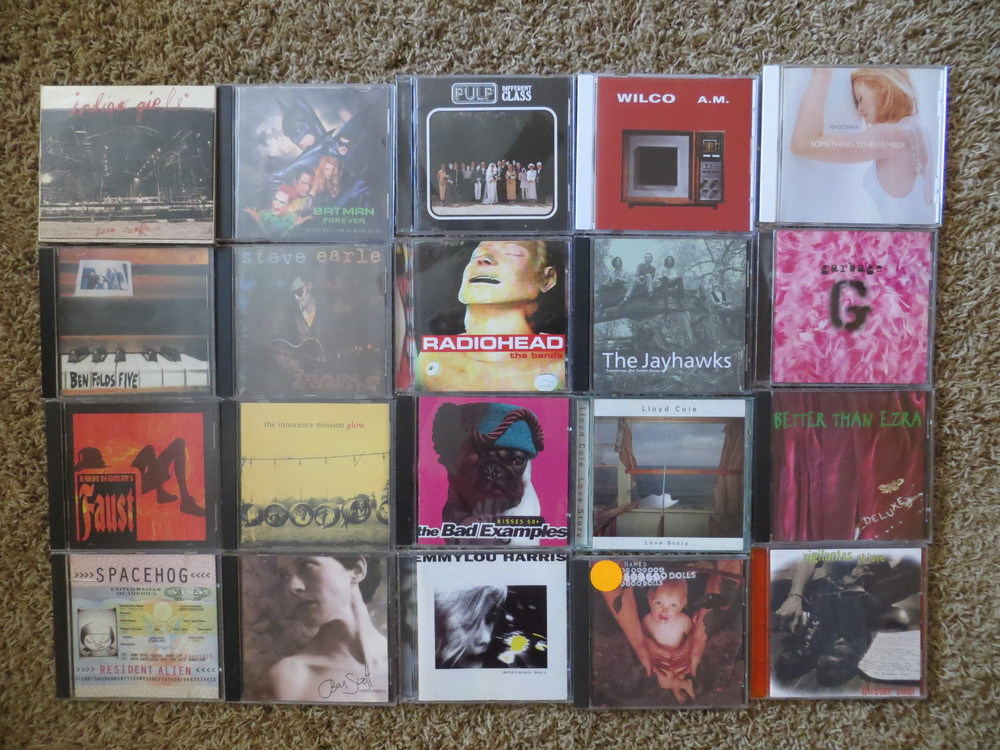
I decided it was my mission to prove him wrong, because my memories of the music of 1995 were quite positive, so I spent a month gathering music from this forgotten year.  What I found in my own collection was enough to make a strong case, but I went out and gleaned another dozen or so bands to feature – some I’d never even heard of before – and then my friend John hopped onto the theme, making an even stronger case.  Last Saturday, four of us got together in Wisconsin to do nothing but play and discuss music.  Here’s what we came up with for 1995.  For me, the first three albums along justify the entire year:

“High and Dry” and “Planet Telex” from The Bends – Radiohead

“Jackson Cannery” from Ben Folds Five – Ben Folds Five

“Common People” from Different Class – Pulp

“Honey White” from Yes – Morphine

“Universal Heartbeat” from Only Everything – Juliana Hatfield

“Downtown” from Mirror Ball – Neil Young

“Not My Idea” from Garbage – Garbage

“Summerland” from Sparkle and Fade – Everclear

“Hold Me, Thrill Me, Kiss Me, Kill Me” from Batman Forever Soundtrack – U2

“Somebody’s Crying” from Forever Blue – Chris Isaak

“You Could Make a Killing” from I’m With Stupid – Aimee Mann

“The Universal” from The Great Escape – Blur

"Just Like Anyone" from Let Your Dim Light Shine - Soul Asylum

“Don’t Look Back in Anger” from (What’s the Story) Morning Glory – Oasis

“Hometown Blues” from Train a Comin’ – Steve Earle

“Radio King” from Down by the old Mainstream – Golden Smog

“That Was Another Country” from Glow – Innocence Mission

“Sandman” and “A Happy Ending” from Faust – Randy Newman

“You Must Go” from Walk On – John Hiatt

“In the Meantime” from Resident Alien – Spacehog

“Brain Stew” from Insomniac – Green Day

“You’ll See” from Something to Remember – Madonna

“Blue” from Tomorrow the Green Grass – Jayhawks

“Awake” from Wholesale Meats and Fish – Letters to Cleo

“My Friends” from One Hot Minute – Red Hot Chili Peppers

“This is a Call” from Foo Fighters – Foo Fighters

“Loose String” from Trace – Sun Volt

“All I Really Want” from Jagged Little Pill – Alanis Morissette

“Every Poet Wants to Murder Shakespeare” from Kisses 50 Cents – Bad Examples

“In the Blood” from Deluxe – Better Than Ezra

“Casino Queen” from A.M. – Wilco

And that’s only what we had time for.  There were many other band represented in 1995 that might have been worthy of our time: Big Country, Emmylou Harris, Smashing Pumpkins, Lloyd Cole, Graham Parker, Collective Soul, Del Amitri, Little Feat, Indigo Girls, Alice in Chains, Goo Goo Dolls, Dishwalla, Bruce Springsteen, Urge Overkill, Prince, Bar Scott, Semisonic, Vigilantes of Love, etc., not to mention jazz, hip-hop and other genres that we didn’t focus on but that undoubtedly had something to offer.

1995 may not have been perfect, but it surely had some terrific stuff.  Sure, for some of these picks I happened to play the one really good song from an otherwise mediocre album.  But you can’t tell me that when the oldies station plays “Happy Together” by The Turtles that you’re wishing the disc jockey had picked a deep cut.  Sometimes the hit is what makes the album.

Then again, I’d put up Radiohead’s The Bends against any album of any year, and it would hold up very well.

So was Kevin persuaded to view the music of 1995 in a new light?  Impressions are tough to overcome, but I think there may be a crack in the armor.  Perhaps Kevin can post a comment below if he cares to interject.

This Business of Music

In Sunday’s Chicago Tribune, Mark Caro offers a terrific analysis of today’s music business that has artists and labels scrambling to tap into on-line sources of income.  Far too often, these sources offer a pittance, calling into question whether artists can continue to create albums and make a living.

That the big labels screwed up and screwed up big in the late 90s when they fought tooth and nail the reality of the Internet goes without saying (and it’s eerily similar to the ongoing battles between Time Warner and local network affiliates – will cable even exist ten years from now?), but it’s doubtful that anyone could have predicted that online streaming would become the primary way people listen to music. 

The very idea of owning one’s music is becoming anachronistic.  Sure, there continues to be a “vinyl revival,” with LP sales increasing almost 6-fold since 2007 (a trend that couldn’t make me happier), but on the whole album sales have reached historic lows, and digital albums aren’t exactly booming either, growing a measly 1.9% in the second quarter of 2013, and possibly declining this quarter.

Which leaves streaming: YouTube.  Pandora.  Spotify.  iHeartRadio.  Slacker.  SomaFM.  For now, these services aren’t providing musicians with the income that physical sales offer.  Rates vary, but according the article, one would need to listen to a song 200 times for an artist to earn $1 on Pandora vs. earning, say, a dollar with a few sales on iTunes.  The argument goes that once these streaming services grow, they’ll be able to pay more to artists (as Spotify has in Sweden), but that remains to be seen.

(for a positively fascinating breakdown of how one artist makes money, check out Zoe Keating's self-reported income as a musician)

More likely, to me, is that music is simply going to become disposable, worth nothing or close to nothing.  In David Byrne’s terrific book, How Music Works, the former Talking Head’s member remarks how music, in a way, has come full circle.  Over a hundred years ago, the only time people enjoyed music was while it was being played.  There was no “owning” music.  You heard it at a performance, and then it disappeared.  At the time, recorded music was something to be feared.  John Philips Sousa warned us against recorded music, saying that it would not only devalue live performance, but impede the yearning to master an instrument:

The child becomes indifferent to practice, for when music can be heard in the homes without the labor of study and close application, and without the slow process of acquiring a technique,…the tide of amateurism cannot but recede, until there will be left only the mechanical device and the professional executant…

Today, both of Sousa’s concerns appear to have been mollified.  Virtuosos are alive and well in every conceivable genre at every possible instrument.  And live performance is the one thing keeping musicians fed and audiences interested.  Performing used to be an artist’s cash cow, a necessary ingredient to spur physical sales.  Today, when access to musical recordings is ubiquitous, live performing is what’s keeping music fresh, immediate and inspiring, and audiences are willing to shell out serious cash to experience it.

In David Byrne's book, he devotes a chapter to revealing the budgets and income of two of his recent recordings.  It's enlightening, but ultimately not indicative of the average musician, since Byrne is still benefitting from the music business's past paradigm.  Things have shifted, and independent artists today aren't reeping the benefits of the 1970s business model. 

Perhaps one day the vinyl revival will really kick it into gear, and life will return to the glorious past yet again, whereby people gather in front of a turntable and take turns listening to the latest releases.  But in the meantime, an artist's bread and butter appears to be performing.  And perhaps that's the way it should have been all along.

The Music of 1979-1980

In our efforts to make music matter again in our lives (see Making Music Matter, part 1 and part 2), a few friends and I met at Kevin’s “Wall of Sound” basement in Wisconsin to play and discuss music from the golden years of 1979-1980, and the results were even more brilliant than I had expected.  What a incredible two year period, when hard rock, punk, new wave, soul, arena rock, fusion, prog rock, folk rock and every other kind of rock you can slap a label on converged for a perfect period of music proliferation.  And get this – most of it was actually played on the radio back in the day!  Crazy times.  1979-1980 might be the strongest two years in my book.  What about yours?

Here’s the list in all its glory – probably close to six hours of music.  It should be noted that music selections were viewed through the lenses of white suburban men who were once white suburban boys.  Notably absent are artists like Kool and the Gang, Isaac Hayes, Donna Summers, Earth Wind and Fire, etc.  We are worse for it.

The Knack – Good Girls Don’t

The Knack – Let me Out

The Police – Bombs Away

The Romantics – Tom Boy

Off Broadway – Bad Indication

Nick Lowe – Switch Board Susan

Roxy Music – Over You

Billy Thorpe – Dream Maker (this is not a good song, but was used to stump Kevin.  It was not successful).

Billy Thorpe – Children of the Sun

Jeff Beck (with Jan Hammer) – Star Cycle

Donny Iris – She’s So Wild (also used to stump Kevin.  This one was successful!)

Donny Iris – Ah!  Leah!

OMD – Red Frame/White Light

Pete Townsend – Let My Love Open the Door

Pete Townsend – And I Moved

Led Zeppelin – I’m Gonna Crawl

Blondie – Union City Blue

Ian McLagan – La De Da (this stumped everyone)

Alan Parsons Project – Snake Eyes

Fleetwood Mac – Brown Eyes

Talking Heads – Air

Rolling Stones – Emotional Rescue

Paul McCartney – So Glad to See You

Joy Division – Love Will Tear Us Apart

Jackson Browne – Boulevard

The Kinks – Moving Pictures

Queen – Don’t Try Suicide

The Police – Reggatta De Blanc

The Cars – Let’s Go

Cheap Trick – Dream Police

Yes – Does is Really Happen

John Cougar – Ain’t Even Done with the Night

Bruce Springsteen – Point Blank

Bruce Springsteen – Cadillac Ranch

The Pretenders – Precious

Supertramp – Child of Vision

Bob Welsh – Precious Love

Rush – Free Will

AC/DC – Shot Down in Flames

Generation X – Kiss Me Deadly

The Kings – Partyitis

The Kinds – This Beat Goes On/Switchin’ To Glide

Neil Young – Powder Finger

U2 – A Day Without Me

U2 – I Will Follow

Rickie Lee Jones – Danny’s All-Star Joint

Bob Dylan – Gotta Serve Somebody

Steely Dan – Gaucho

Dr. Hook – Sexy Eyes

REO Speedwagon – Don’t Let Him Go

Yipes – Out in California

The Eagles – In the City

Head East – It’s Got to be Real

The Clash – Lost in the Supermarket

The Damned – Jet Boy, Jet Girl

Joe Jackson – On the Radio

Van Halen – D.O.A.

Journey – Too Late

Kansas – Hold On

Genesis – Turn it on Again

Talking Heads – Once in a Lifetime

Tom Petty – Even the Losers

Elvis Costello – Senior Service

Joan Jett – Bad Reputation

Aretha Franklin – Think

Aerosmith – Three Mile Smile

Aerosmith – No Surprise

Al Stewart – Midnight Rocks

Muppets – Rainbow Connection

Peter Gabriel – No Self Control

Elton John – Little Jeanie

Not too shabby a list!  And we didn’t even touch Pink Floyd, Billy Joel, Prince, The B-52s, Michael Jackson, Graham Parker, Robert Palmer, Santana, Kiss, ELO, Chaka Kahn, Pat Benatar, Dire Straits, ZZ Top, Toto, Styx, etc.

Tell me a two year period that’s better.  There might be!

Copyright, 2026, Paul Heinz, All Right Reserved