Paul Heinz

Original Fiction, Music and Essays

Filtering by Category: Reviews

Review: Jackson Browne in Chicago

At sixty-six, Jackson Browne could easily phone it in and play concert after concert of the certified hits that came with regularity during the first decade and a half of his 40-plus year career, but on Tuesday night at the Chicago Theater he went a different route, playing deep cuts and new material along with a few crowd-pleasers for a balanced and effective show. 

Beginning with 1996’s “Barricades of Heaven,” 1972’s “Looking into You,” and two songs from his new album Standing in the Breach, it was apparent that this wasn’t going to be a greatest hits show, and the evening was all the more rewarding because of it.  Browne stitched his new material seamlessly with his older tunes, which you could take one of two ways I suppose: 1) his new material is as strong as his old material; or 2) his new material explores the same territory he’s been exploring for decades.  It’s probably a little of both, but when you have an absolutely stellar band with equally stellar sound backing you up, and you’re reciting lyrics like: The seeds of tragedy are there/In what we feel we have the right to bear… well, I’ll take a little familiarity with my new Jackson Browne.  All told, he performed seven songs from his new album.  If you had asked me beforehand if that was a recipe for a successful evening, I would have demurred, but to my ears many of the new tunes were as strong as the old ones.

After being assaulted at several arena shows lately, I was thrilled to be able to hear every instrument on stage without reaching for the earplugs, and I spent much of the evening admiring the guitar work of Val McCallum and Greg Leisz (who played dobro, guitar and lap steel), both absolute monsters at their instruments, and one got the feeling that Jackson Browne had as much fun watching these guys display their craft as he did singing his compositions. 

Alternating between guitar and piano throughout the evening, Browne sported an all-black outfit (as did the rest of the band), and the stage lighting bathed the musicians in shades of violet, with occasional splashes of color to enhance various songs, most notably the desert shades of “Leaving Winslow,” a song Browne introduced with a childhood memory of playing on a trestle bridge with his buddies and flattening pennies on the railway.

Early in the second set, Browne asked, “What would you like to hear?” and after a deluge of requests, he answered, “Yeah, I thought so.  But after that what do you want to hear?”  But as far as I could see, the request resulted in only one audible, the 1980’s hit “In the Shape of a Heart,” and the rest of the evening proceeded much as his previous concerts in Philadelphia and New York. 

I knew I could leave a happy man after Browne performed 1993’s “I’m Alive,” albeit a whole tone lower than his studio recording.  It became apparent during the show that keys had been adjusted to accommodate Brown’s aging voice, but that said, his signature mellow tone still sounded excellent, and I got the feeling that he could have hit the high notes consistently had he been forced to.  If there was one complaint about the evening, it’s that the band played on a similar energy level throughout with little in the way of dynamics; even some of the rockers came off sounding country.  But this is a minor quibble, and for the last selections of the concert, Browne broke into crowd favorites and rocked a bit with “Doctor My Eyes,” “The Pretender,” “Running on Empty” and “Take it Easy.”

As I was buying junk food at Walgreens after the show, a woman behind me said to her boyfriend, “I was hoping for ‘Late for the Sky.’”  I was too, but I give Browne a lot of credit for playing so much new music that was actually worth playing and worth hearing.  He continues to sing about the stuff that matters, from the Haiti earthquake, to politics, to the Gulf oil spill.  We need guys like Browne to continue to fight the good fight and to be willing to put new music at the forefront.  I'll take that over a greatest hits show any day.
The Movie, Chef

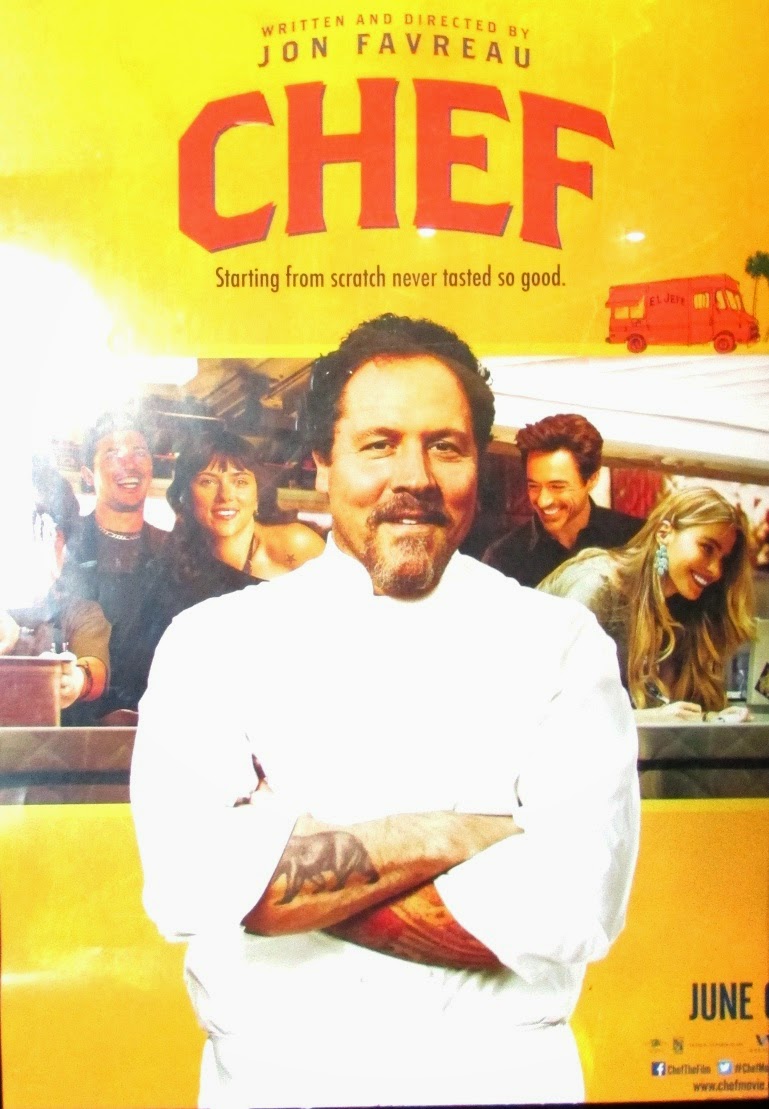
When Jon Favreau made his big splash in the movie Swingers back in 1993, who could have predicted that he’d be playing a supporting role on TV’s Friends just a few years later?  The guy was clearly destined for bigger things.  Fortunately, since then he’s managed to carve out a nice resume of screenwriting, acting and directorial credits (Elf, Iron Man) and in his latest movie, Chef, he does all three in an absolute gem of a film.  I haven’t had this much fun at a movie all year. 

Favreau plays Carl Casper, a professional chef in LA who finds himself compromising his art due to restaurateur Dustin Hoffman’s insistence that he stick to the tried and true.  A novice at social media, Casper learns just enough from son Percy (Emjay Anthony) to become dangerous, and a series of self-induced mishaps – culminating in a videotaped tantrum in front of food critique Ramsey Michel (Oliver Platt) – puts him back on the job market, lost and uncertain of what to do next. 

At the prodding of Casper’s ex-wife, played by Sofia Vergara, Favreau and son begin a new business in Miami on a food truck, assisted by former line chef, Martin (played by the incomparable John Leguizamo).  They city-hop across the country, learning a few things along the way about fatherhood, work-ethics, and how to use social media as one’s advantage.  More importantly, the plot allows Favreau to show us his love affair with Miami, New Orleans and Austin, and the music and food that makes these cities come alive.

Favreau could have taken many predictable turns that would have made Chef yet another contrived Hollywood mess, and true, things are sewn up a little neatly at the film’s end, but the journey along the way is such a terrific romp, both sweet enough and irreverent enough to rope in my 12 year-old son (which ain’t easy), that a little contrivance toward the end is acceptable.  It’s not often a movie balances things so well (Favreau’s excellent Elf is one example), and Chef lends credence to the notion that a well-done character-driven film is often more interesting than a plot-driven film (though having both is even better).

Big name stars Robert Downey, Jr., Scarlett Johansson and Dustin Hoffman (not to mention Oliver Platt) all land terrific performances in small roles, but Leguizamo, sous chef Tony (Bobby Cannavale) and Favreau steal the show, along with Favreau’s father-son relationship with Anthony.   The dialogue seems natural and unforced, and Favreau’s obvious love of cooking shines, as he affectionately devotes numerous scenes that reveal just how much effort people are willing to expend – all for the pleasure of a fine meal. 

The Movie Boyhood: See it

The monumental achievement of Richard Linklater’s latest movie, Boyhood – in which he follows the fictional lives of a family for a dozen years – might be easy to overlook without first comparing to other art forms to put things into perspective.  Imagine asking a musical artist to record one song in one month out of the year for twelve years with the intention of making a seamless 12-song album.  The Beatles couldn’t have done it.  Led Zeppelin would have failed at this endeavor.  Michael Jackson?  Forget about it.  What about asking an author to write a chapter in one month out of the year for 12 years to create a tight, page-turning novel?  A near impossible endeavor.

Artists evolve.  Their interests change.  Their skills change.  Technology changes.  Artists immerse themselves in a project often at times to the detriment of everything else going on in their lives, and if they’re lucky, their myopic pursuits result in a near-perfect piece of art.  That Linklater was able to achieve the latter despite taking twelve years to do it is nothing short of remarkable.

In Boyhood, starring Ellar Coltrane, Lorelei Linklater, Patricia Arquette and Ethan Hawke, twelve years pass before our eyes, as the characters evolve and age in mostly very ordinary ways.  Richard Linklater began filming in 2002 and wrapped up finally in 2013, all the while directing a number of other movies, including the second and third installments of the “Before” trilogy, which – like Boyhood – are also a study of time and the ordinariness of life. 

As the film progressed, I – far too accustomed to the typical movie experience – waited for tragedy to strike: a rape, a car crash, a stupid drunken accident.  And though the movie isn’t absent drama, it does illuminate what I wrote about just a week ago: that normal everyday lives are interesting in and of themselves.  Linklater sets up a few scenes where something awful could have occurred, only to proceed without fanfare.  I believe this was done on purpose, as it shows just how tenuous our lives are, as we take risk after risk after risk on a daily basis, only to find that most of the time, we escape unharmed. We manage to survive in spite of our carelessness.

At two hours and 45 minutes, the movie for me was about twenty minutes too long, and Arquette’s character’s inability to recognize a man’s shortcomings grew tiresome, but those are minor quibbles.  More important was an observation my daughter made about the main character, Mason, played by Ellar Coltrane.  She said that Mason was a walking cliché for the emo subculture, whereby every cynical, morose viewpoint is spouted as unique and interesting in spite of it being taken straight out of the emo handbook.  Here’s a summary from http://uncyclopedia.wikia.com/wiki/Emo

Emo is a type of subculture…loosely rooted around punk rock with its own distinct style of music, fashion, argot and other trappings in a desperate, though ultimately hopeless attempt to pronounce their uniqueness. As a rule of thumb, a person described as "emo" will often be from a comfortable, middle-class background with liberal parents. All of this is irrelevant to an emo who will consider themselves misunderstood and repressed regardless of reality…They all suffer from severe narcissism, leading them to believe that they alone know what pain is, and that no one understands them…on the plus side, emos have made great strides in the fields of photography.

Well, damn.  My daughter was spot-on!  The character of Mason is in fact a walking cliché.  But guess what?  So are a lot of the people we meet every day.  Sure, I think it would have been more exciting if Mason had been an outgoing guy who was into sports or drama or music, but Linklater needed to let the film evolve as the actors evolved, and my guess is that the fictional Mason wasn’t too far removed from the real-life Coltrane since the script was written over the 12 year-period and very much tailored to the actors involved.

That this film came to fruition is a minor miracle.  So many things could have gone wrong: actors could have died or decided they didn’t want to finish the project.  A major life event in any of the actors’ lives could have put the project on hold.  What would have happened had it turned out that the girl or boy couldn’t act?  Somehow Linklater keeps it all together, and manages to allow time to elapse before our eyes without editing flourishes; sometimes a new scene begins and only upon seeing an older Mason do we realize that a year has passed.  Linklater similarly avoids sentimentality (except for one completely unnecessary scene in a restaurant).  I imagine that in the hands of another filmmaker, Boyhood would have succumbed to the token flashback near the film’s end, whereby Arquette recalls the early lives of the children she’s sending off into adulthood.  Yes, I would have bought this type of flashback hook, line and sinker – I love that kind of crap – but I give Linklater credit for refusing the low-hanging fruit.

See the movie.

Real Life on Film: Joe Swanberg

Real life is always more interesting than the worlds of dragons, gods, superheroes, magic and fairies.  And I’m not even talking about life’s extremes of murder, war, leading nations, kidnapping and drug abuse  – though to be sure, these can create some remarkable works of art.  To me, the very mundane things that link most people's lives – hanging out with friends, meeting someone you like, working a job simply to pay the bills – are some of the richest veins for authors and filmmakers to tap into. 

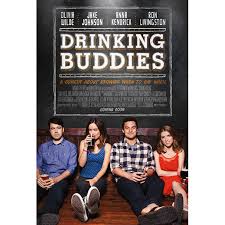
It isn’t surprising that films about the mundane should sail a bit under the radar, especially for a middle-age guy living in the suburbs, and that’s where journalism can come to save the day.  I recently read a piece by the Chicago Tribune’s Christopher Borrelli about filmmaker Joe Swanberg, a guy I’d never heard of before despite his having directed fifteen films.  Lo and behold, his movie “Drinking Buddies” is currently streaming on Netflix, so yesterday I checked it out.

It’s a gem.

Like much of Richard Linklater’s work, or the films of Noah Baumbach, Edward Burns, Whit Stillman, and – on occasion – Woody Allen, Swanberg’s “Drinking Buddies” is about capturing everyday life in all it’s fabulous glory: the modest slights that can turn a mood, the quips that buoy one’s spirits during a long workday, the small error that can become enormous or can be dismissed with a heartfelt kiss.  With spot-on performances by Jake Johnson (of New Girl fame), Anna Kendrick, Ron Livingston (remember him from “Office Space”?) and the captivating Olivia Wilde, “Drinking Buddies” is at its essence about nothing more than real life.  No car chases.  No murders.  No emotional or physical abuse.  No supernatural interference.  It’s about the lives that most of us lead and that carry an infinite amount of laughs, tears, anger and joy.

Sure, I don’t really believe that women who drink as much as Kendrick’s and Wilde’s characters do could actually maintain their figures (I attended UW-Madison and witnessed first-hand the results of four years of drinking), but that’s about the only aspect of the film that didn’t ring true. 

Swanberg – a Chicago resident – has another movie starring Kendrick out in theaters now called “Happy Christmas,” and as soon as I see that, I’m going to start in on his back catalogue.

Now tell me that newspapers no longer matter.

Movie Review: Begin Again

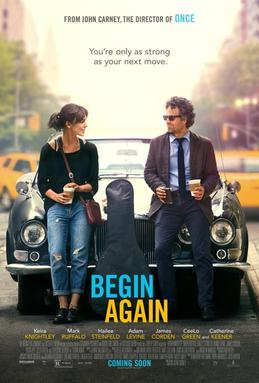
Begin Again, pairing Keira Knightley and Mark Ruffalo, is nothing if not an ode to music, and I’m a sucker for films that reveal the inner workings of the music industry or the magic of composition.  Even the remake of The Jazz Singer escapes a BOMB rating in my book since we get to see Neil Diamond sing “Love on the Rocks” in the recording studio.  But when it comes to music in film, two terrific movie moments come to mind: Illeana Douglas's character singing the Costello/Bacharach tune, “God Give Me Strength,” in Grace of My Heart, and the moment in Once when the heretofore inattentive recording engineer finally begins to notice the magic happening in the studio as the band plays “When Your Mind’s Made Up.”  I’m not sure anything in Begin Again quite matches either of these scenes (despite being directed by Once director John Carney), but many come close, and the film tells a terrific story with appealing characters to boot.

Ruffalo is a down-and-out record label exec who happens upon a little less down-and-out Knightley, who’s fresh off a breakup with Adam Levine.  She sings a heartfelt song in an East Village bar prior to her return to England, and Ruffalo, desperate to find a performer who might end his streak of signed failures, immediately recognizes her potential.  In a particularly effective scene, we get to hear (and see) what Ruffalo’s character hears: not just a woman singing on-stage to a guitar, but a song that slowly builds to the accompaniment of piano, cello, bass, guitar and drums.  This works beautifully, and illustrates just how well a film can reveal the transcendental nature of music.

Through a series of well-done flashbacks, we learn the details of Knightley’s and Levine’s relationship, as well as that of Ruffalo and his ex, Catherine Keener, whose daughter Hailee Steinfeld provides the most contrived plot points in the movie (that she would take fashion advice from Knightley and that – lo and behold – she can play guitar well enough to record a tune on the first take).  Levine does a fine job as a rising star who’s falling for the trappings of fame, and CeeLo Green provides the film some street cred.  James Cordon, who plays Greta’s friend from England, is basically a more amped up Glen Hansard from Once, though a little less believable.

The film requires us to suspend belief on a few points, as Ruffalo never fails to find ample parking in New York City, easily finds public places to record a band, and manages to attract superb string musicians willing to play for free.  But whatever.  It’s a good story, not reaching the height’s of Carney’s Once, but a perfectly enjoyable ride, and so much better than most movies in which music is a major character. 

If there’s one thing I could change about the film, it would be the slick production of the songs themselves.  Here we are, watching an ensemble record songs live on a New York City street, but we hear none of the natural flaws and ambient noise associated with such an endeavor: instead, everything’s perfect, from the local kids singing backup vocals to Steinfeld’s guitar solo.  Such is the world we live in, as auto-tune and click tracks have taken over even some of the grittiest bands.  But think of what made Once so magical: the belief that the characters were performing HERE and NOW. Why Carney decided to gloss things up so significantly after achieving such perfection eight years ago is perplexing.

Copyright, 2026, Paul Heinz, All Right Reserved