Paul Heinz

Original Fiction, Music and Essays

Filtering by Category: Music

20 Rush Albums in 20 Days: Caress of Steel
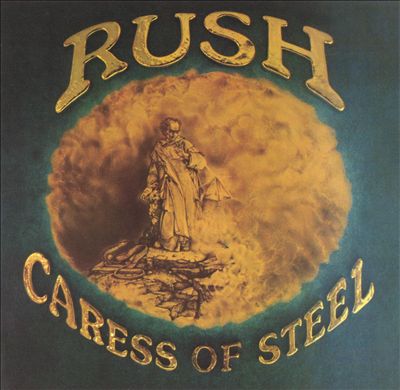
DAY TWENTY: Caress of Steel, running time 44:59, released September 24, 1975

Caress of Steel, an album I’ve long considered to be Rush’s worst, is not as bad as I remember.  In fact, it has a lot of things going for it, though I admit I won’t likely be listening to it again anytime soon.  This is an ambitious effort, a full 7 minutes longer than Fly by Night, with the band’s first side-long song, “The Fountain of Lamneth.”

The opening song “Bastille Days” is basically “Athem 2,” a rip-roaring number that was a live favorite for a number of tours.  The band shows its first signs of a sense of humor on the throw-away track, “I Think I’m Going Bald,” a song that would have been better suited on Rush despite it being penned by Peart, and the very accessible “Lakeside Park” is a pleasant tune, oddly out of place considering what’s to transpire (and the guitar is annoyingly panned all the way left during the verses for some inexplicable reason).

“The Necromancer” is Rush’s second venture into the land of extended, multi-section pieces, and it’s an effective one save for the warped, slow-tape narration.  The first movement – the song’s best – is a moody, repetitious, minor-keyed movement reminiscent of a Pink Floyd jam, and the second section brings to mind “Cygnus X-1” with its sudden starts and stops.  The growl of By-Tor come back briefly, but unlike on the Fly By Night album, Geddy wisely get’s out of the way of Lifeson’s solos (regrettably panned back and forth, an amateurish and unnecessary production trick), and the last section has a fine, three-chord outro (think “Sweet Jane”) that gives the song a melodic, positive lift.

Hearing “The Fountain of Lamneth” for the first time in years, I found it alternately brilliant and regrettable.  The first section, “In the Valley,” opens with a beautiful descending acoustic guitar pattern and melodic lyric that would play very well live as part of a largely medley, but then Geddy screeches his way through the next part.  The minute-long “Didacts and Narpets” is unfortunate in every way except that it’s only a minute long.  “No One At The Bridge” recalls the first section of “The Necromancer,” with a moody, hypnotic verse and terrific guitar solo; the only issue is the bridge when Geddy sounds like he’s about to tear his vocal chords apart (and not in a good way).  He takes it down several registers in the next two sections, and they are better for it.  “Panacea” is a flowing ballad, and “Bacchus Plateau” is the album’s most accessible tune, a three-chord pop song at its essence; if this were separate from the rest of the side-song piece it might have been a modest radio hit, and if Geddy could still hit the notes, it would be a great live piece. “The Fountain” ends the album side where it began, offering the listener some familiar territory, a helpful bookend.

So where does it stand head-to-head against other Rush albums?  It's hard to say.  Comparing Caress of Steel to, say, Snakes and Arrows, is like comparing two different bands.  In a way, they are two different bands.

Twenty albums in twenty days!  Tomorrow, I’ll be summarizing my journey, and then I’m taking a week to listen to some other music.

20 Rush Albums in 20 Days: Clockwork Angels

DAY NINETEEN: Clockwork Angels, running time 66:04, released June 12, 2012

Listening to Clockwork Angels, one gets the feeling that Rush enjoyed writing and recording this album.  Unlike Snakes and Arrows, there’s a sense of exploration and joy on this effort, with shifting moods, exciting riffs, some great hooks and plenty of moments that challenge each member of the band.  It’s easily the band’s best effort since Test for Echo, and quite possibly their best album since the early 80s.

The opening “Caravan” immediately provides the hook and infectious chorus so often lacking in later Rush material, setting the stage with the universal chorus of “I can’t stop thinking big,” and “BU2B” provides an exciting opening riff and a memorable refrain. 

The album gets bogged down a bit with the unnecessary effects and interludes.   There’s hardly a guitar part that isn’t bathed in effects, filling up the entire stereo spectrum, and beginnings and endings of songs are extended with traces of vocal and guitar parts swept with ethereal effects, sometimes serving to give the listener a respite from the onslaught of sound, other times doing nothing but prolonging what should have been a much shorter effort.  This isn’t Rush of 1981, after all; they are not at their prolific best.  An album of 50 minutes would have been preferred.

A silly megaphone effect is employed on two successive songs: the title track, and again at 1:55 of “The Anarchist” before going back to a terrific chorus.  As with many recent Rush songs, too often they write great parts of songs without writing an effective piece from beginning to end.  “Carnies” is an example of a track whose verse is a complete mess, but whose other sections work extremely well.

“The Halo Effect” is a complete song – probably the album’s best – melodic from the start, accessible, with universal lyrics, and one of the few times in recent memory that a Rush song ends exactly when it should at just over three minutes.  “The Wreckers” is another gem, perhaps going on a minute too long (particularly at the bridge at 2:50), but again a very good verse and chorus with a contagious guitar intro.

“Headlong Flight” is a blistering seven minutes of pure joy, employing brief allusions to Rush of yesteryear, including riffs from “Bastille Days” and “By-Tor and the Snow Dog.”  It’s a powerhouse that I would expect to be included in any future tours the band might make, though I wonder if Clockwork Angels might be Rush’s swan-song.  It wouldn’t be a bad way to cap off a forty-year career.

As with so many hard-rock albums these days, Rush squashed the sound too much in the mastering process.  You can practically hear the limiter pumping at 1:10 of “Seven Cities of Gold” as Geddy reaches for the high notes.  I also noticed it at 2:43 of “Carnies.”  Not a preferred production technique, but it’s unfortunately been the trend of heavy rock music for the past decade.  Listen to A Farewell to Kings back to back with Clockwork Angels and you’ll hear just how much production has changed since the 70s, and not all for the better.

“The Garden” ends the album with an touching summary of what one takes away after a long life of ups and downs.  And then…it says it again and again, for almost seven minutes.  But oh well.  Such is the reality of an ambitious band in the CD age (though we’re almost out of that age, I would suspect).  

Tomorrow, I’ll be listening to Caress of Steel, a very weird way to end a twenty-day journey.

20 Rush Albums in 20 Days: Snakes and Arrows

DAY EIGHTEEN: Snakes and Arrows, running time 62:45, released May 1, 2007

Snakes and Arrows has been compared with the Rush recordings of the late 70s.  It is anything but.  Four huge distinctions: the busier, grungier production; the less melodic vocal parts over meterless poetry; the minor-key leanings; and the overall length of the recording.  Now, that doesn’t necessarily suggest that it’s a poor effort, and there is a younger generation of Rush fans who love this album.  For me, Snakes and Arrows is a laborious listening experience, like wading through an endless sea of mud.  Sure, it feels kind of cool during those first few steps, all squishy and thick, but before too long, your calves hurt and your toenails are full of gook.

My major gripe is the minor key drudgery of the songs.  So dark, so monotone, so unsingable, one after another after another.  Nearly every song begins and ends in a minor key, each sounding much like the one that preceded it.  As I’ve stated before, I’m a melody guy for the most part, but the lyrics here – like many of those on Vapor Trails – once again feel like they were jerry-rigged into the songs; meterless, rhymeless poetry that doesn’t lend itself well to tunes.  Try singing the verses to “Armor and Sword.”  If you can do it, you are a better man that I (or maybe just a bigger Rush fan).  And the verses of “The Way the Wind Blows” are an absolute mess, undermining a fine chorus.  Now, nothing says you can’t have lyrics that are difficult to sing and that don’t lend themselves to traditional melodic phrasing, and Rush seems to have embraced this technique as of late, but for me, it simply doesn’t provide for a pleasurable listening experience.

The album starts off strong with “Far Cry” and there’s enough good stuff happening in “Spindrift” for me to recommend that song (I love the simplicity of the musical theme and the chorus), but even this song loses its way during a wretched bridge with Geddy backing himself up on vocals (a technique he employs way too often).  That’s about as much as I’d care to return to if I was compiling a best-of Rush mix tape.   Rush’s nineteenth album is clearly a superior effort than Vapor Trails in terms of production, but as far as the songs go, I actually prefer the earlier release.

Snakes and Arrows features three instrumentals, which isn’t a bad idea for an aging band known for its virtuoso instrumentalists.  If they worked at it, Rush could actually make an album entirely of instrumentals.  But here, they’re just okay, lacking the melodic themes of a “YYZ” or even a “Where’s My Thing,” serving more as interludes between vocal songs than as features.  “The Main Monkey Business” goes on forever without going anywhere, but “Hope” is a nice Lifeson piece, again aimless, but short and pleasant.

Tomorrow, I’ll be listening to…drum roll, please…number 20, Rush’s latest, Clockwork Angels, which means that in two days I’ll be ending my journey with the polarizing Caress of Steel.  That outta be interesting.

20 Rush Albums in 20 Days: A Farewell to Kings

DAY SEVENTEEN: A Farewell to Kings, running time 37:13, released September 1, 1977

2112 was a very good album with great musicianship, but the compositions were harmonically and rhythmically basic.  Not so on Rush's followup, A Farewell to Kings.  Here, the band pushes the envelope, shifting moods with the effective use of tuned percussion and synthesizers, juggling time signatures and producing one of its finest albums to date.

A Farewell to Kings is all about creating atmosphere, and it often takes its time getting there.  Lifeson’s classical guitar that opens the album brings to mind Old England, and the guitar swells that open “Xanadu” evoke mystery and wonder (and lead to my second-favorite Lifeson guitar part of all-time at 1:48).  It takes a full five minutes before Geddy sings a note, and it’s this deliberate pace that works so well on the album.  Despite the album’s brief length, Rush is in no hurry to get anywhere, each track transpiring all in good time.  The marriage of tuned percussion and synthesizer at various points (5:59 of “Xanadu,” for instance) work well, and the musicianship is stunningly good throughout.

Side two opens with a radio-friendly tune (I can only imagine the relief Mercury Records must have felt upon hearing it), “Closer to the Heart,” with its universal lyrics and terrific solo by Lifeson, and “Cinderella Man” is another gem (the cheesy use of panning during the guitar solo notwithstanding) penned by Lee.  Both of these tunes are better than any of the shorter tracks on 2112 with the possible exception of ”A Passage to Bangkok.”  The band had grown in leaps and bounds in one year.  Even the ballad “Madrigal” works beautifully and benefits from brevity, something Rush should have considered with “Rivendell” just a few years prior, and it also works better than the ballad “Tears” from 2112.

The album ends with another ambitious effort, “Cygnus X-1,” and once again the pacing is superb.  After a brief spoken introduction, it isn’t until minute five that Geddy begins to sing.  The song rocks at that point, only to recede at 7:15, building the tension required to highlight the song’s inevitable, blistering conclusion. The strummed guitar chords at the song's end leave the listener with a sense of mystery and suggest the song's sequel, ”Hemispheres."

In short, A Farewell to Kings may not be the album you want to listen to in the car between errands after work, but if you’ve got some time to sit back and take it all in, you might not find a better Rush album.  It’s likely going to be number two on my list.

Tomorrow, I’ll be listening to…drum roll, please…number 19, Snakes and Arrows, one of those efforts that newer Rush fans worship.  We’ll see what this old guy thinks of it.

20 Rush Albums in 20 Days: Roll the Bones

DAY SIXTEEN: Rush, Roll the Bones, running time 48:04, released September 3, 1991

For me, Roll the Bones is the sister of Presto, much like Hemispheres and A Farewell to Kings, Signals and Grace Under Pressure, Power Windows and Hold Your Fire, etc.  It seems like Rush tends to pursue a sound for two albums and then moves onto new endeavors.  Here, they continue the more prominent guitar sound (albeit trebly, crunchy guitar without much meat to it) with keyboards providing a significant bedding; it’s not yet the harder-edged full sound of Counterparts, but it’s getting there. 

Gone are the days of silence between the notes.  On Roll the Bones, there’s always something filling in the soundscape – a droning keyboard, the long ring of a snare’s reverb, an overdubbed guitar – a trend that started with Signals (and I’m not sure has stopped yet), and this the only part of the production that drives me a bit bonkers.  A little more dynamic range and an occasional moment of silence would have been welcome.

But this is a minor quibble.  Roll the Bones is an excellent album.  There are Rush fans who hate this era of the band, but for me this album is smack dab in the middle of Rush’s second golden era (the first starting at 2112 and ending at Moving Pictures).  You’ve got good melodies over a rocking, upbeat sound, mostly in major keys (something anathema to the band on Snakes and Arrows), but the biggest asset is Peart’s accessible, relatable lyrics.  Yes, he makes the lyrical sin of rhyming “chance,” “dance” and “romance” (seriously – what’s next?  Cool, fool and school?  Love, dove and above?), but then he throws out gems like “Distance is a long-range filter/Memory a flickering light.”  Here, Peart writes of fate, youth, chance, randomness, circumstances, love, dreams – all relatable stuff for a band that used to write about black holes, monsters and battling gods.

The rap in the title track is a lot of fun, and the band played it for many years on tour, almost to the point of being overplayed (much like “Dreamline” and “Force Ten”), but here too Alex mucks up the rap by playing lead guitar over it.  Silly.  “Bravado” and “Heresy” are fantastic slower songs with terrific messages, and the chorus of “Ghost of a Chance” is as close to adult contemporary that the band has ever come (and you know what?  It’s fricking good).  Rush wisely limits the album's length to 48 minutes plus, a full four minutes less than Presto.  Even still, the album loses some of its momentum with the final two tracks, “Neurotica” and “You Bet Your Life.”  Still decent songs, however, and when push comes to shove, Roll the Bones is on par with Presto, which for me means definitely in the top ten albums that Rush has produced.

Oddly, selections from this album have been hard to come by live.  Only five tracks were played on the Roll the Bones tour, and since then, only three have made it into the rotation.  I would love to hear “Heresy” or “The Big Wheel” live – something other than the first three tracks – but as usual Rush leans on familiar ways.

Tomorrow, I’ll be listening to…drum roll, please…number 5, A Farewell to Kings.  This album had me mesmerized when my brother purchased what I remember to be a cutout of this 1977 release.  We’ll see if it still has the magic.

Copyright, 2026, Paul Heinz, All Right Reserved