Paul Heinz

Original Fiction, Music and Essays

Filtering by Category: Music

20 Rush Albums in 20 Days: Signals

DAY FIFTEEN: Rush, Signals, running time 43:12, released September 9, 1982

The change between Moving Pictures to Signals is enormous, the latter providing a richer texture with more keyboards, a fuller sound and an electric violin to boot.  Even Geddy’s voice is different here, as he uses his lower register throughout and employs heavy reverb and delay.  I was expecting not to like Signals very much, and to be sure, it falls flat on a few tunes, but it held a few pleasant surprises for me. 

The first two tracks should be surprises to no one.  The album begins with Geddy’s low synth – talk about “signaling” a change in the band’s direction – and continues with Neil Peart’s best lyric ever in “Subdivisions.”  “The Analog Kid” is among the band’s best ever, offering a brief return to a heavier guitar sound before heading back to the rich keyboard sound of “Chemistry,” a good track that struggles mightily to overcome its cheesy lyrics (credited to all three band members!  Not sure three heads were better than one in this case).  “Digital Man” is a great track that would sound right at home on Grace Under Pressure, with Alex’s crunchy chord-driven guitar part.  Here, the band employs keyboards just the right amount, not as a lead instrument but as a texture-adding element, even contributing a rhythmic pulse during the chorus, a technique used on the next track as well, “The Weapon.”  This song that starts strong before laboring about half-way through, especially during the instrumental section that offers dated keyboard patches and little forward momentum (a sign of what was to come on some of the songs from the band’s next release).

Just as the album begins to drag a bit, “New World Man” does for Signals what “Kid Gloves” does for Grace Under Pressure, breathing new life and energy into the mix, with a running time of less than four minutes (and serving as Rush's highest-charting single ever).  I’d never been a fan of “Losing It,” but today I really appreciated the verses that dance over the initial 5/8 rhythm.  Lovely stuff.  It’s also cool that Lifeson was willing to share soloing duties with Ben Mink’s electric violin, but like “The Weapon,” this song loses steam about half-way through.  The last track, “Countdown,” is a bit of time capsule, both musically and lyrically, and for me it was never one of Rush’s stronger tracks, as it meanders through too many different sections without offering enough of a hook.

When I saw my first Rush concert in October of 1982, they played every song from Signals except “Losing It.”   In recent years, “Analog Kid” has made a welcomed comeback, and “New World Man” and “Digital Man” have been played as well within the last decade or so.

All in all, a good recording, probably on par with Grace Under Pressure, though I think I favor the latter just a bit more.

Tomorrow, I’ll be listening to…drum roll, please…number 14, Roll the Bones, as Rush throws its hat into the world of rap.  Get ready…
20 Rush Albums in 20 Days: 2112

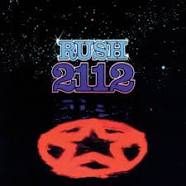
DAY FOURTEEN: Rush, 2112, running time 38:44, released April 1, 1976

Rush decided to go for broke on their fourth album, and the bet paid off.  Were it not for the success of 2112, the band would likely have a four-album history, little more than a 70s rock band footnote.  It’s hard to believe that the band members were only 22 and 23 years old at the time of the album’s release, and perhaps it’s the ideology and audacity of youth that allowed them to take the risk they did.

The first side of the album, the epic side-long “2112,” still holds up as well as it ever did.  What struck me was how simple it is harmonically and rhythmically.  Except for a few measures here and there, the entire piece is in 4/4 time, and each section offers simple chord sequences.  True, Rush still shows off its chops through its playing, but not yet in its composition (that would begin with the next album, A Farewell to Kings).  What distinguishes this effort from other side-long pieces is its relatable story with defining characters, its distinct sections and its variability in dynamics.  Unlike, say, Hemispheres, which mostly maintains a full-throttle approach, “2112” allows for room to breathe, from the spaces between notes in “Overture” to the over three minutes from 6:54 to 10:13 when the only instrument to be heard is Alex’s guitar.  This is unheard of in Rush’s repertoire in the last thirty years, where less is never deemed enough, opting instead for massive overdubs and unwelcome sound effects that clutter the landscape.  Here, we really get to hear the story and relate to the first-person narrator (something “Hemispheres” lacks for the most part) and take a breather between the priests’ outbursts.  Geddy Lee expertly alters his voice between the doomed narrator and the all-powerful Priests of Syrinx to help the listener along.  It all works so well, though as I’ve noted before, if I’m ever welcomed by a liberator who booms in a deep foreboding voice, “We have assumed control,” I’m going to keep a packed suitcase by the door just in case.

Side two doesn’t hold up as well.  “Passage to Bangkok” works beautifully with its infectious opening riff and hummable chorus, but for me “The Twilight Zone” is just so-so, and “Something for Nothing” sounds like it belongs on Caress of Steel with its screeching vocals.  “Lessons” and “Tears,” with lyrics by Lifeson and Lee respectively, have some nice parts to be sure and would have been welcome additions on the previous two albums, but here come off sounding a bit week compared to the rest of the album.

2112 presents a band that is still evolving, yet to reach its highest heights, but taking a huge step in the right direction. 

Tomorrow, I’ll be listening to…drum roll, please…number 9, Signals, the first Rush tour I ever witnessed. Does the follow-up to Moving Pictures match its predecessor?  Stay tuned. 

20 Rush Albums in 20 Days: Test for Echo

DAY THIRTEEN: Rush, Test for Echo, running time 53:25, released September 10, 1996

Quick: name the only Rush album whose opening track has never been played live beyond the tour that supported that particular album.  You guessed it: Test for Echo, a largely unrepresented album on Rush tours, with only two songs, “Driven” and “Resist,” cracking the set list since 1997.  Perhaps for that reason it’s easy to overlook this album, and many Rush diehards consider this among Rush’s worst efforts.  But try listening to it again and you might conclude that it’s actually among the band’s best in the last thirty years.  I did.

Continuing the trend started on Counterparts (with the same producer, Peter Collins, who also produced – as difficult as it is to believe – Power Windows and Hold Your Fire), Test for Echo zips along with a heavier, guitar-oriented sound, powerfully blending effective riffs, technical time signatures and memorable melodies.  What else are you looking for from Rush?  The opening track seemed an odd choice to me back when it was released in 1996 since I was used to the energetic, spirited number to kick off an album, but “Test for Echo” sets the mood perfectly, mirroring the bewilderment expressed in the lyrics of a pop culture that glorifies crime. “Half the World” – a radio-friendly song reminiscent of “New Word Man” – didn’t even make the live album from this tour, but to me it’s a terrific piece with compelling lyrics and a great hook, and “Time and Motion” is a barnburner that harkens back to Rush of the early 80s; it’s my favorite song from the album.  Even more accessible tracks like “Virtuality” have some incredible moments, with a driving opening riff before resolving into a pop-friendly chorus.  This was a song I sort of dreaded listening to with its cheesy lyrics, but today it worked for me.  Tomorrow, perhaps not.  Opinions are finicky things.

The only two tracks that truly stumble on the album are “Limbo,” a meandering instrumental with no discernible hook, and “Dog Years,” a song that starts off fine before losing its air on a lackluster chorus and an even worse outro.  And on the otherwise good track, “Resist,” Geddy overcomplicates things by harmonizing his lead vocal part throughout, muddying a melody that’s only allowed to shine on the live version from Different Stages.  A few of the tunes have one section too many, as if Lee and Lifeson felt compelled to include every line of Peart’s lyrics.  “Virtuality” is one example.  The section that begins, “Let’s dance tonight to a virtual song” detracts from the rest of the piece, and “Dog Years” and “Totem” follow similar courses.

Ultimately, the best of Test for Echo isn’t quite as good as the best of Counterparts, but its weaker tracks are better, making the album a more solid, consistent effort. 

Tomorrow, I’ll be listening to…drum roll, please…number 4.  I’ll be rewinding a full two decades to the album that kept Rush from calling it a day: 2112.

20 Rush Albums in 20 Days: Hemispheres

DAY TWELVE: Rush, Hemispheres, running time 36:14, released October 29, 1978

Sitting down to listen to Hemispheres this morning, I expected what some consider Rush’s most self-indulgent album (and indeed, the band itself subtitles their lengthy instrumental “La Villa Strangiato” “An exercise in Self-Indulgence”) to be a bloated mess.  Instead, I was surprised by how fresh and exciting it sounds, even showing signs of minimalism along the way.  It’s a snappy, ambitious effort that highlights Rush’s virtuosity while still presenting memorable and accessible melodies.

“Hemispheres,” a sequel from the previous album, is lengthy at eighteen minutes, but it doesn’t get bogged down under its own weight.  The prelude effectively touches on all the prominent themes, thereby anchoring the listener in what’s about to transpire, and the sections are well laid out with interesting time signatures and memorable melodies.  The piece takes a momentary respite in the section “Cygnus,” which reminds me a lot of how Yes took things down a notch during their magnum opus “Close to the Edge” in the “I Get Up, I Get Down” section.  The only thing “Hemispheres” lacks is the compelling story that made “2112” such a terrific vehicle for a side-long song (“Clockwork Angels” suffers the same comparison).  The battle of the heart and mind simply isn’t as interesting as oppressive forces shattering a person’s discovery of music.  Nonetheless, it’s a good piece, and the ending (“The Sphere”) is one I keep hoping Rush will one day play live.  It’s such a beautiful, short piece and still within Geddy’s vocal range, that it would make a wonderful encore.  The audience would explode.  Perhaps one day.

Side two offers two shorter tracks, “Circumstances” and “The Trees,” that both take advantage of dynamic changes during their respective instrumental sections (something the previous album I listened to, Power Windows, could have benefitted greatly from), and the former offers a heretofore rare glimpse into a first-person Neil Peart, something he’ll explore more and more in the upcoming albums.  The 9-minute “La Villa Strangiato” is Rush’s first legitimate instrumental, and it works on so many levels.  After a terrific classical guitar opening by Lifeson, the song begins a long crescendo into a very unpretentious three-chord theme before going off into some more elaborate directions.  What I really like about this tune, aside from it’s obvious playfulness during the “Monsters!” theme (a rip-off, by the way, of Raymond Scott’s “Powerhouse” – a fact that resulted a payment by Rush to Scott), is the way Geddy gets the hell out of the way at 3:40 and lets Lifeson do his thing, which he does oh so well for the next two minutes.  It’s a fantastic example of how less is more, and it’s among LIfeson’s most impressive and effective guitar solos.

This was the end of the line for Rush’s penchant for lengthy sci-fi pieces, and greater things were soon to follow as the band began to balance shorter, more accessible pieces with slightly longer, more ambitious efforts.  In this sense, perhaps “The God of balance” in “Hemispheres” was a prescient symbol of the band’s musical journey.

Tomorrow, I’ll be listening to…drum roll, please…number 16, Test for Echo, the end of an era for Rush before personal events forced a six-year interruption.

20 Rush Albums in 20 Days: Power Windows

DAY ELEVEN: Rush, Power Windows, running time 44:44, released October 29, 1985

When I saw Rush in Chicago in 2012, I was surprised that the band played not one, not two, not three, but four songs from Power Windows.  An interesting choice, since this album is the antithesis of recent efforts that focus on a hard-edged, fuller guitar sonic landscape.  I suspect there were many in the audience who were less than happy about it.  I was thrilled to hear “Territories,” my favorite off the album, and maybe one more would have been fine.  Four seemed to be pushing it just a bit.

This is the album when Rush made a conscious decision not to worry about being able to reproduce things live.  From this point on, the band would lean more and more on prerecorded tracks, triggering them with foot pedals or synth keys, and their live performances became a little less live.  Even easy synth parts, like the beginning of “The Big Money,” are not played live by Geddy Lee.  I’m not sure why that is, but I suspect it has something to do with the band’s insistence of having their live tracks sound virtually identical as the studio versions.  This is a mistake in my mind.  Great bands like Zeppelin or The Who conquered the stage by doing just the opposite, with each performance unique and unpredictable (to a point).  Imagine seeing Rush perform a song and not knowing how different it might be than the night before?  It could produce some very interesting results.

Listening to Power Windows today, the opening songs – “The Big Money” and “Grand Designs” – sounded fresh and exciting, with more prominent guitar work than I remembered.  Sure, there are frilly synth sequences that kind of muck things up, but overall I enjoyed the experience.  The next two tracks, “Manhattan Project” and “Marathon,” are again good songs, but suddenly Alex becomes less and less important, and by “Territories” he all but disappears during the chorus.  From there, the album really breaks down for me.  The tracks vary so little in mood, tempo, rhythm and production, that by the time I get to “Middletown Dreams,” “Emotion Detector,” and “Mystic Rhythms,” I’ve simply had enough.  Each song sounds unpleasantly similar to the song that preceded it.  The album could have benefitted greatly from a tune featuring an acoustic guitar, a ¾ time signature or a less in-your-face synth sound – something to mix things up a bit.

Rush has said that if they could re-record an album, Presto would be it, but I think Power Windows would get my vote.  Each song might stand on its own merits, but having eight songs in a row with so little to distinguish them makes the listening experience bland and unpleasant.  It would be very cool to hear the band try some of these songs as a basic rock trio.

Tomorrow, I’ll be listening to…drum roll, please…number 6, Hemispheres, the last Rush album to offer a side-long song.  Talk about a different feel!  We shall see how it holds up.

Copyright, 2026, Paul Heinz, All Right Reserved