Paul Heinz

Original Fiction, Music and Essays

Filtering by Category: Movies

The Phrase "Spoiler Alert."

The invention of the phrase “spoiler alert” has got to be one Man’s greatest linguistic contributions over the last decade or so.  Philip B. Corbet of The New York Times has rightly pointed out how overused the phrase has become, and how it’s often used incorrectly, but for my money, overuse is preferable to the alternative.

I think of the woman who came to my home in 2002, and who – after eating our food – thanked us by divulging the ending of the movie, The Others.

I will do for you what she didn’t do for me.

!!!!SPOILER ALERT!!!!

She opened up that pouty little mouth of hers and spewed out, “I couldn’t believe it when I learned her children were dead.”

She is very, very lucky that I didn’t resort to the following (or worse): 
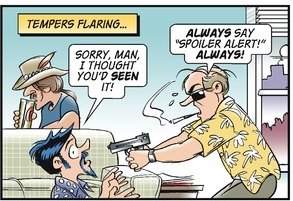
After her egregious case of vomit of the mouth, it didn’t matter to me if she was smart or pretty, if she’d overcome obstacles in her life or helped the needy.  I couldn’t possibly care less if she gave twenty percent of her earnings to charity or if she was raising three perfect little angels.  None of that shit mattered to me.  What mattered is she opened her mouth and ruined the ending of a movie I was excited to see.  Yeah, the film had already left theaters and moved into video stores, but to me, there is no statute of limitations when it comes to revealing secrets about a piece of art.

I still haven’t told my kids about the ending of Psycho.  I’ll never divulge the meaning of Rosebud, whether or not Thorwald really murders his wife, and where the quarter of a million dollars is hidden in the movie Charade.  That’s for them to discover.  And I sure as heck won’t mention a word about The Sixth Sense.  Sure, I could try to ease my kids’ anxiety and mention !!!SPOILER ALERT!!! that the ghosts are actually trying to help, that they’re good guys (never mind the movie’s Big Secret).  I resorted to this tactic when my kids were younger watching E.T. for the first time.  !!!SPOILER ALERT!!! “The bad guys are actually good guys,” I said, attempting to alleviate their trepidation, but I’ll never do this again.  It kills the journey.

Some people just don’t get it, including – unfortunately – much of my family.  Last summer my sister-in-law blurted out the secret behind the musical, Next to Normal, the same day my daughter was to see it.  And just last month, my mother, in response to an email of mine indicating that I wanted to see the movie Enough Said, wrote the following email !!!SPOILER ALERT!!!:

I fell in love with the Soprano guy, what an appealing person.  Was Julia's character vulnerable, screwed up, or just terribly unkind?

Yep.  So now I know the ending of that movie, too.  Thanks, Mom.

I think when it comes to discussing books, films and theater, we could look to my sister for guidance.  Her advice for living in a world in which the excretion of opinions is as commonplace as breathing is this:

Shut your trap.

42: A Film that Polishes the Past

Watching the Jackie Robinson biopic 42 last week, I couldn’t help but feel that I was watching ABCs movie-of-the-week in a theater.  Sure, the acting was good (it was great to see Harrison Ford actually act instead of relying on smirks), the story is of course compelling – it practically begs to be filmed – and the film does a reasonably good job of telling the story.  Chadwick Boseman and Nicole Beharie do fine as Jackie and Rachel Robinson (even when they have to spout cornball dialogue).  What’s troubling is how unreal the film looks and feels.  So little attention was made, aside from vintage cars and clothing, to make it feel like 1946-47.  Instead, we get a polished version of the past.

In 42:

No one sweats.  Seriously.  No one.

No one smokes.  (For a sense of how smoking should be used in a period film, check out this scene from Good Night and Good Luck)

All clothing is new, clean and pressed.  No dirt.  No grime.  No tatters, even of the clothing from kids in Florida, who I presume weren’t exactly rolling in the dough.

Everyone is beautiful (except for the bigots), from the lead characters to the woman who babysits the Robinson’s son.

Baseball jerseys, even after nine innings of play, are bleach-white.  We only see dirt directly after Jackie dives or slides into a base.

All men are clean shaven or have neatly trimmed beards.

In short, it has the look and feel of The Truman Show or Pleasantville, except this isn’t supposed to be a farce of a 1950s sitcom.  This is supposed to be a film dramatizing real life, not an antiseptic version of the past.  Some directors are so careful to make films look realistic, but Brian Helgeland misses the boat on this one.

He also falls short on the screenplay.  It’s amazing how the writer of such terrific films as Mystic River and LA Confidential managed to write such contrived, cornball dialogue.  Maybe Jackie and Rachel Robinson really did have a marriage as strong as the one depicted in the movie, but it doesn’t make for good film.  No arguments?  About anything?  Never anything mundane to say?  Only perfectly executed love notes to each other?  I’d put good money on the real-life Rachel Robinson actually being a full-fledged three-dimensional woman.  Instead, Nicole Beharie does what she can with a two-dimensional script.

See the film, if only to watch it with your kids, as it may provide an education for them about racism and baseball’s tarnished past.  But for the most part, the past has been polished in 42, keeping the story from ringing true.  One has to wonder how good this film could have been in the capable hands of a filmmaker like Spike Lee.

Roger Ebert

An eerie coincidence: two nights ago, I spent a half an hour watching an old Siskel and Ebert movie review at http://siskelandebert.org/ of one hell of a week for movie lovers.  During that week in 1982, they reviewed Tootsie, The Verdict and Sophie’s Choice.  Not too shabby. 

The next day I found out that Roger Ebert had died. 

This news jolted me, as I’d just been watching the forty year-old Ebert offer his witticisms the night prior, and though the news saddened me, I’d already felt the loss of no longer being able to watch new versions of the great show both he and Gene Siskel left behind.  Fortunately for us, two other film lovers have helped catalogue these old reviews at http://siskelandebert.org/ (though I notice the website was down earlier today.  We can only hope this was because of too many hits and not because the powers that be at Disney/ABC – the owners of all the “At the Movie” episodes from 1986 through 2010 - have thrown their weight around and filed a lawsuit.  For more on the stupidity of Disney/ABC, click on a blog of mine from a year ago).

Siskel and Ebert’s show was part of my life due to my mother’s influence, when in the 1970s we tuned into the show “Sneak Previews” on PBS.  We even watched for a while after Siskel and Ebert’s departure, but before long we turned back to the critics we’d grown to love at their new show, “At the Movies.”  Always interesting, sometimes enlightening, and almost always entertaining, the weekly show helped to solidify in me what was already becoming a fascination with the movies.

For any of you who missed how insightful and entertaining movie criticism can be, look no further than their 1990 discussion (at minute 14:40) of the anti-Semitism accusations people made of Spike Lee for his film, Mo’ Better Blues. As both a film lover and a Jewish man, Siskel handles the subject deftly, while Roger Ebert displays his innocence by admitting he didn’t even know the characters were supposed to be Jewish (I didn’t either back in 1990).  It was a grown-up discussion before the days of the Internet when name-calling and browbeating weren't the norm.

Both Gene Siskel and Roger Ebert will be missed, with or without a video record of their contributions to film criticism, but what’s mindboggling to me is how a similar show can’t succeed today.  Aren’t their two skillful writers out there who’ve got some personality and who can provide movie lovers with a show in the same vein as “At the Movies”?  Even an Internet-only broadcast would be acceptable to me.  If one exists that I'm simply not aware of, please leave a comment at the end of this blog.

An aside: I should also note that in 2011 I happened to be listening to an Amy Winehouse song at the same time I later found out she was dying, and now Roger dies hours after I watch a review of his.  For those of you whose blogs I read, watch out.

The Perks of being an Author who writes his own Screenplay

We’ve all read good books that made terrible movies (“The Great Gatsby,” “The Bonfire of the Vanities,” and “Bee Season” come to mind), and some good books that made good movies whose final product bore little resemblance to the original (“The Shining,” “Breakfast at Tiffany’s.”).  But what makes a good film based on a book?

Often, it comes down to the screenplay.  The new film, The Perks of Being a Wallflower, succeeds largely because of the continued involvement of Stephen Chbosky, who authored the 1999 epistolary novel, wrote the screenplay and directed the movie.  As such, the integrity of the material wasn’t compromised.  There are no Hollywood endings (Breakfast at Tiffany’s), no invented characters (Diary of a Wimpy Kid), no weird plot twists (what exactly was the point of the character Halloran in Stanley Kubrick’s version of The Shining?).  All the important plot points are there.  All the critical dialogue is there.  And since the book was only 170 pages or so, the novel didn’t need to be butchered to make it onscreen.  Yes, the Harry Potter movies are good, but so much material was relegated to the cutting room floor that some hardcore fans felt cheated.

I’d never heard of Chbosky’s novel before, but after reading a review of the movie, my daughters and I quickly read an ebook version of Perks and saw the movie to a mostly empty theater on a Thursday night.  Too bad, because the experience was moving and exhilarating, one of those rare examples of a film not only matching the book, but matching the absolute best in the genre of teenage coming-of-age movies.

Chbosky has written screenplays before, most notably the underwhelming film adaptation of the musical Rent, but the experience clearly paid off with the challenging task of adapting his own material.  The first ten minutes feel a little clumsy and forced as the characters and essential information is introduced, but once the characters are firmly established, the movie takes off.

Emma Watson of Harry Potter fame acts four years her junior in the movie, playing step-sister to Ezra Miller.  Together, the seniors befriend outcast freshman Logan Lerman, who’s struggling to find his place in the wake of personal difficulties, but he soon finds that his newfound friends have personal struggles of their own.  That Watson and Lerman would befriend a freshman so fully is perhaps a plot point that’s difficult to believe, but if you can suspend that bit of reality (and the reality that Lerman is actually a freshman – he’s twenty in real life), then you’re in for a beautiful ride.  It’ll be leaving theaters soon, but mark it down as a definite rental a few months from now.

On a side note, I must mention that Innocence Mission’s “Evensong” astonishingly made it onto the soundtrack of the movie.  I have no idea how this obscure track from an obscure album from an obscure band from 1991 made it into the film, but it was so good to hear.

The film Argo: Go See It!

I should first note that any movie that highlights Led Zeppelin’s “When the Levee Breaks” and The Rolling Stones’ “Little T&A” is bound to please me to a certain degree, no matter the acting or subject matter (Van Halen’s “Dance the Night Way” wasn’t too shabby either).  That “Argo” hits all the marks in a deftly executed historical thriller is more than just icing on the cake; it’s as close to perfection for the genre as any I’ve seen, and for me it’s the best film since 2007's “Michael Clayton.”

“Argo” tells the true story of six would-be American hostages who instead flee to the Canadian embassy.  How to get them out is the question, and CIA agent Ben Affleck has a plan: to pose with the six as Canadian film-makers scouting out locations in Iran for a science fiction movie called “Argo.”  Sound crazy?  It did to me, and still does. 

I was old enough to be very aware of the hostage crisis back in 1979, and I remember the blindfolded Americans being paraded through the streets of Tehran.  Affleck, both an understated lead and a capable director in this feature, manages to shift between real footage and fictionalized scenes seamlessly, taking viewers back to that time period in a flash.  I even had a touch of nostalgia watching younger versions of Tom Brokaw, Ted Koppel and Walter Cronkite grace the newscasts of yesteryear.

The opening scenes, in which the mobs of protestors storm the embassy, are chilling, especially in light of the Americans who lost their lives in Libya last month.  Sometimes history repeats itself.  Affleck does a good job of offering a quick tutorial for the uninformed at the film’s opening, summarizing the hostage crisis and what led to it (what led to it?  The actions of the U.S. Government twenty-five years prior.   History doesn’t just happen, folks.  History results from unintended consequences.).

Affleck pulls every suspense string he can clutch near the film’s conclusion, and although I knew exactly what he was doing and that I was being manipulated, I didn’t particularly care.  I just know I would never have been able to pull off the ruse of pretending to be a filmmaker while gunmen questioned me.  I was nervous enough as a viewer.  I would also like to read about actual events to see how much the screenplay was doctored up for the benefit of the film.  If things indeed happened as Argo depicts, then I think I can sum up my reaction in two words: Holy Crap!

Ben Affleck has followed the lead of co-producer George Clooney in smartly handling his Hollywood career, wisely taking on smaller projects that are perhaps a bit under the radar, but are sharp films that please critics and cult-audiences alike.  Take Clooney’s “Good Night and Good Luck,” a masterfully done historical thriller, multiply the intensity ten-fold, subtract the black and white, and you get “Argo,” including the cigarette smoke, this time inhaled by guys with cheesy mustaches instead of the suave look of the 50s.

John Goodman is also doing a nice job of managing his career, and after his mostly silent performance in “The Artist,” it’s great to see him and hear him in action, along with Alan Arkin, as Hollywood filmmakers.  There are a dozen other faces you’ll recognize, and all were wise to take bit roles in what is bound to be an Oscar contender.

Yes, you heard me right. 

Then again, “Michael Clayton” didn’t win best picture, and last year Roman Polanski’s “Ghost Writer” didn’t even get nominated.  So what the hell do I know?

Copyright, 2026, Paul Heinz, All Right Reserved